Anxiety

Once upon a time, about 27 years ago, in the spring, I was driving through town with a lot on my mind, nothing special really, just a lot going on.  I felt normal enough…  Then it happened.  I wasn’t prepared.  It had never happened to me before, at least not like this.  I knew life had my plate filled to overflowing but so what, that was nothing new or unusual.  Three young children, a job, a home, a busy husband, and overcommitted finances.

We’ve all been there a time or two, right?

The sun was shining, I was driving alone in the car (which was unusual, I guess, because I was most often a kid taxi), and suddenly… I had to pull over.  I couldn’t breathe.  My heart felt like it was beating out of my chest, like maybe I was having a heart attack.  My thoughts were racing, my hands were shaking, and I didn’t know what to do.  I was in trouble.

I took a couple of deep breaths and tried to relax.  Phones were not as prolific as now, so I did not have one with me.  I couldn’t call for help.  I tried to keep from panicking as I saw my life flash before my eyes.  Nothing seemed right.  Everything felt surreal, almost out of body-like.  I don’t know how long I sat in my car on the side of the road, but my breath eventually became even, my heart stopped racing, my tears dried up, and my hands steadied.  I drove home.

When I got home, I called my dad.  He was a physician and my trusted ally.  I told him what happened, and he asked me if I had a rash on my body.  I remember thinking that was an odd question, and I was stunned that he knew.  How did he know I had an angry hive-like rash all over my body?

“It was a panic attack,” Dad said.  He suggested I unload some stuff from my overfilled plate and rest more… Easier said than done.

The only other time I had a similar experience was years later following the words, “You have cancer.” After that shocking announcement, I walked out of the doctor’s office into the fresh, sunny air and lost it, totally lost it!  Couldn’t breathe, couldn’t control my erratic heartbeat, sobbed uncontrollably… You get it.  Enough said.

It’s surprising how much I am hearing about anxiety these days.  Everywhere I turn, it seems I see articles and social media posts and hear conversations about these very difficult days we are living in – These COVID days, with employment uncertainty, life relocation becoming a norm, online school still in the headlines, political dissension, health fears, Zoom meeting interruptions – These are stressful days!  Anxiety pierced days.  Even new puppies can be stressful and cause anxiety. Trust me, I have one!  People everywhere are feeling overwhelmed and fearful.

As long as I have known Doug, he has been my stable, chill, enduring comrade. Quick-witted and confident. Don’t misunderstand me, we have been married 38 years.  I have seen him mad before, sad, confused, frustrated, and overwhelmed, but I haven’t known him to be anxious or fearful.  In fact, Doug is famous for one-liners that hint at the way he does life.

The one-liner I most often repeat is, “More will be revealed.”  Patience and acceptance are all over that.  He is also known for saying, “Living the dream,” when someone asks him how he’s doing. “One-day-at-a-time” and “Keep it simple” describe how he travels through life and “This is not my home” and “God is in control”, basically sums up his spiritual convictions.

Sadly, his childhood was difficult.  Some stories he shares about his young years can bring a chill up my spine.  He told me, as a child, he was anxious.  I can imagine that to be true.  Even so, anxiousness is not a familiar behavior I attach to Doug.

Until recently.  Until FTD

Frontal Temporal Degeneration (FTD) is a dementia type that is often associated with behavior change.  I understand that the behavior variant of FTD can cause a person to become erratic, angry, and unpredictable.  Fortunately, that has not been our experience.  Doug’s behavior hasn’t changed much, at least not drastically or permanently. 

During Doug’s FTD diagnosis at Loma Linda University Neuropsychology Center, the testing was stressful, and the doctor used the word anxious to describe Doug’s behavior.  I was surprised.  I did not know Doug to be anxious, and his “anxiety” did not present like my experience with anxiety at all.  He didn’t have a full-blown dramatic panic attack where he couldn’t breathe and had heart palpitations and loud sobs amidst tears.  The anxiety that showed up in Doug during diagnosis was almost silent – he withdrew into himself.  Just stopped.  He stopped talking to me and relating to things around him.  He became apathetic and withdrawn, with bouts of nervous, fidgety, agitated energy.  He retreated, checked out, and paced.  It took about three days following this early FTD anxiety before he was back to his normal, relaxed, calm Doug. 

My reactions to this experience were scared, uncomfortable, and lonely.  I felt helpless.  I decided then, in all my puffed-up prowess, I would do all I could to try to control Doug’s environment enough to keep him out of those stressful experiences and thwart anxiety and the decline of dementia whenever possible…

Are you laughing yet at how powerful I thought I was?  You should be!

I used to try to solve and regulate dementia like a temperature control on a thermostat. I spent lots of hours reading and researching and hoping and wishing, with my guard up, that somehow, Doug was different and would not experience the unfriendly parts of this disease.   But alas, that is not the case.  I now realize we will not escape unscathed.  The dementia brain will do what the dementia brain will do, no matter how hard I work to control it. FTD brain change happens unpredictably and erratically.

We have been on this journey long enough to notice times of stability and decline.  But predicting those intervals is hopelessly hard, and preventing them is impossible.

Sadly, Doug is currently in decline, and anxiety has reared its head – quiet, internal, unsettling anxiety laced with nervous, fidgety energy.  While watching evening TV recently, he said to me, “I’m anxious.”  The announcement of his self-diagnosis was noteworthy.  Doug’s language is impaired, along with his awareness.  So, to plainly state how he was feeling gave me pause.  When I asked him a clarifying question to better understand how anxiety was affecting him, however, Doug answered with his typical muddled and confused messaging.

I let out a sigh.

Maybe I sighed because the answer was muddled and confusing, and I hoped for better.  But more likely, I sighed because anxiety in Doug reminds me that dementia doesn’t take a vacation.  It keeps pushing onward like an engine on a mission.

The truth is, I sigh and cry more often and more easily these days.  I am finally less intense about controlling the outcome (which is good for my overall well-being), and I am more connected with reality right now.  Meditatively, I frequently take deep breaths and concentrate on relaxing my shoulders, my forehead, and my jaw in a slow, intentional exhale as I say a prayer for Doug. For me. For us.

Even as dementia trudges on, this prayer practice helps remind me God is in control, I can trust Him, and more will be revealed as I keep it simple one day at a time.  

Karen

Traveling Lost

I do not like the feeling of being lost.  Being lost gives me hives.  It makes me breathe erratically and I wring my hands. Okay, that’s a bit of an exaggeration, but not by much.  When I’m lost (which isn’t very often because I have an aversion towards it) I think thoughts like: “What if I never make it back?  Do I have my affairs in order and are my wishes put where people who care can find them? Does anyone care? I really should have told him/her where I was going… or where I thought I was going.   Why didn’t I drop breadcrumbs or tie a bandana… somewhere…”

Doug used to love being lost.  He considered it a great adventure.  I considered it a waste of time, usually a waste of money, and always a waste of precious energy I could be using to save the world somehow.  I have said it many times, the invention of the GPS single-handedly saved our marriage.

When we returned from a European excursion that included a trip to Spain, England, Scotland, and a few other hotspots, we were thrilled with the photos.  The one of Doug and me on London’s Tower Bridge is a favorite.  So is the amazing sunset over the Mediterranean. But some photos we have of that trip confuse me.  They are beautiful and green, some with sheep, a sheepherder, and a barn.  One with a cobblestone street and an amazing arch.  One of a town square… I look at those pictures and I have no idea where we were.  Looking at those pictures raises my blood pressure a point or two because it reminds me how lost we were most of the time.

The truth is, traveling with Doug was traveling lost most of the time.  And the craziest thing is, he usually preferred it that way! 

We were in the middle of Spain in the middle of nowhere with no idea where we were or how to get back to our luggage that was safe in a cozy hotel room with a view.  Out on this lonely road, after aimlessly wandering for what I considered “way too long” we happened upon a road construction crew fixing a random hole in the road.  Doug decided to stop and ask for directions because he was tired of listening to me whine.

I was curious how this would go.

Doug knew not a word of Spanish.

He approached one of the construction guys, showed him a map, and shrugged his shoulders with an exaggerated hand gesture that clearly communicated he was lost.  After pointing and nodding and smiling and finally shaking hands, Doug returned to the car, made a U-turn and we were back to the hotel by dark.  He saw the whole experience as a grand adventure.  I was exhausted.

By the time we finished up the trip in London, I was leading Doug around, with map in hand, and refusing to follow him anywhere off the beaten path. To my credit, that’s when we got the great picture of us on the London Tower Bridge.

I am not wound quite as tight as I was back then, but I still don’t enjoy being lost.

Recently I took Doug to the grocery store.  It was crowded.  I felt responsible to keep him close because cluttered environments can be unsettling for him and get him easily turned around. Dementia complicates even the simplest or most common activities quickly.  In Doug’s dementia normal, he no longer enjoys being lost.  Being lost, especially in a crowded environment, can cause him penetrating anxiety.

Doug is typically calm when I am within arm’s reach.  He is okay when he can see me, but he is quickly beside himself if he loses track of where he is or where I am.    To my chagrin, Doug often follows behind me like a duckling following its mama.  I get why he does that, even though I feel a bit like the Pied Piper of one.  It makes it easier for him to see me. 

I have learned that dementia affects vision (it affects everything eventually, but vision is one of those subtle surprises that happens when you’re not watching). For Doug, his peripheral vision is affected.  I have been told that the vision can become cave-like.  It is like peering through a pair of binoculars or wearing horse blinders. Over time the vision becomes almost exclusively forward-focused. Doug doesn’t verbalize this about his eyesight, but he does say he likes things out in front so he “knows it’s there”.  He turns his head, and sometimes his body, in a formal sort of way to the right and to the left to see things you and I would see peripherally.

I prefer Doug to walk alongside me and not play follow the leader. When grocery shopping, I will sometimes hold his hand or have him help me “push the grocery cart” by holding onto the cart with at least one hand. Doing this forces him to walk beside me, where I can see him, instead of behind me, where I cannot. The caveat, however, is that he struggles to see me peripherally when he is beside me, triggering lots of head-turning and general uneasiness.

We had finished shopping and were preparing to join a checkout line. I carefully scanned, trying to determine which line would be the quickest and easiest for us. I was counting carts, analyzing their contents, and evaluating the proficiency of the checker.  If the checker is newish at the job and a cart is heaping with produce, you can forget getting out of there before your next appointment.  I know you know what I mean.  We all do it!  If the cart has a bunch of soda, cereal, chips, dog food, and no produce, then a quick checkout is a sure thing. 

My scan led me away from the hired help and to the self-checkout line.  It would be faster… I thought. I didn’t consider the produce in my cart, the eggs, and the fact I had more than 15 items – I guess there is a rule that nobody talks about, but everyone expects when using the self-checkout line, 15 items or less! 

I began by awkwardly scanning the oatmeal container.  I could not find the bar code. The scanner wouldn’t beep.  Impatiently I looked at Doug (who was oblivious to my struggle) and then at the checker who was overworked with 6 or 8 (too many) self-scanning stations in her charge.  I felt the eyes of the people in line boring into me because I was slow. I had maybe 17 items (more than 15 for sure), and Doug wasn’t helping.  I could hear the critics questioning, really loud in their heads, “why is he just standing there, he should be helping her.”

The self-checkout grocery store line peer pressure was mounting.  I used the picture lookup button to ring in the Produce because I didn’t realize it is important (when doing self-checkout) that all the Produce you pick should have a barcode sticker attached. It makes it way easier! I was slow and flustered, I admit it.  But the real issue happened when I picked up the eggs. 

Yep, the flimsy carton sagged, and three eggs fell out and broke onto the scanner. Now I had the attention of the overworked checker and the people in line!  The checker swooped over, rag in hand, and went immediately into cleaning mode.  She handed Doug the flimsy carton of eggs (I assumed to move it out of the way) and then said to him, “Why don’t you go get another carton of eggs.” My brain, at this point, was on overload, and my agitation was intensifying.  Doug, going to get eggs was not an option! He gets lost in the grocery store if his back is turned to me. Roaming through the store trying to find the egg section was an impossibility.  I boldly, probably too loudly, completely flustered, said, “No! No, he won’t get eggs. I mean, he can’t. No… I will just take the eggs.”

I grabbed the damaged carton of eggs out of Doug’s hands and shoved them into the bag.

The checker looked totally befuddled.  She had no idea why I responded as I did.  She didn’t know Doug has dementia or the difficulties involved with taking him shopping with me in an effort to break up the monotony of his days. She was completely unaware of the pressure I feel to keep Doug healthy and happy, well-fed, and entertained.  She didn’t realize that being lost anywhere, even in his own home (which is a reality), can cause penetrating anxiety.  She didn’t understand that when out and about, Doug needs an escort everywhere he goes, even to the bathroom.  She didn’t know that Doug is the best person I have ever known and that I miss him terribly every day.

No, she was just an innocent, lovely person doing her job when I lost it.  I couldn’t get out of the store fast enough.  I felt like the walls were pressing in on me, like I saw once on a Batman and Robin episode when I was ten.  I grabbed Doug’s hand and forcibly led him out of the store with the broken eggs bobbing precariously atop the bag.

Dementia affects everyone, not just the one with the diagnosis.  Days can be good, and days can be not so good.  With dementia, traveling lost is routine.  I am learning how to forgive myself for being the one who’s lost and for those uncharacteristic outbursts.  Meditation, taking a deep breath, and prayer help with that.  So does making peace with the moment.

I calmed down as I placed my arm around Doug’s waist and walked with him slowly back to the car.  “It’s okay”, I told myself. “We’re okay,” I said to him, “and right now, in this moment together, we have each other, one day at a time”.

“One day at a time,” he repeated.

Karen

Sounds of Silence

Those of you who know me know I am extroverted, and I like to talk. My primary school teachers and the principal knew that fact without question. So did my high school swim coach, my best friends, and my dad. Words are, and always have been, my engine. They fuel me. They guide and direct like a compass. My career choices have leaned heavily on language – writing, public speaking, lecturing, instructing, one-on-one dialogue. I even have a master’s degree in communication and leadership!

So, words are my thing.

Some people would say music is their thing, or painting is their thing, or technology, astrology or economics, or dance is their thing. This thing is the thing that helps make your world go around. It communicates to you and through you. It has probably been your thing since day go. I like to talk and listen and dialogue back and forth. I also like to read and write (hence this blog) and expand my vocabulary. Words give me the leverage I need to solve a problem or direct the traffic of my life. 

The use of words can calm me down, like when I read a bedtime story to my grandkids or listen to meditation with headphones, or they can energize me like when I meet a friend for tea and have more to say than I have time.

Doug found pleasure in teasing me about needing to “use up my words”. When the children were young and I spent more hours serving small toddlers than I did interacting with the world, Doug would come home from work and be barraged by my daily unspoken – turned verbal – thoughts. He heard everything from what the kids did throughout the day to my opinion about world events. Doug learned very early in our relationship that it was easier to nod and give an occasional “uh-huh” now and then as I spewed the plethora of my thoughts than to have any opinion at all about any of my musings. His listening and my talking fortified me.

Doug’s opinions came later. 

He let me talk and talk and talk, and then, when the timing was right (which was often on a different day), he would revisit my words, remind me about what I said, and then give his opinion. I valued his opinions (most of the time). 

Doug would think and then speak. He was often funny, sometimes right, sometimes wrong, and commonly gentle in his interpretation of my oration. I came to appreciate his usually well-thought-out delayed feedback and conversation.

The track star, Jesse Owens, says, “If we walk long enough and talk long enough, we might come to understand one another.” I just love this quote and believe it wholeheartedly.

Doug and I used to walk the river trail. It was a beautiful long nature trail with stunning river and canyon views behind our house, where we raised our kids to be adults. The two of us would walk together and talk together and come to understand each other on this trail. We talked about everything we cared about. We discussed whatever was top of mind at the time and whatever needed to be considered. We laughed sometimes, and we cried sometimes. We decided things on those walks. Basic things like which toys went under the Christmas tree. Things that mattered more, like the best college for our graduating senior. Even the really tough things like the optimal time to sell our memory-filled family home. On that river trail, I learned, I talked, I listened, I trusted, I ached, I argued, and I grew up. Those walks and talks are now some of my most precious marriage memories. Sigh.

Dementia, more specifically Frontotemporal Dementia, more specifically still Primary Progressive Aphasia, is chipping away at Doug’s language faculties. His ability to follow and understand language, formulate words, ideas, and opinions, and his ability to express, using the limited language skill he still retains, is steadily becoming silenced. He spends much of his day quiet.

Of course, I still use up my words on his ears. It’s my thing after all. But more importantly, it is my one-dimensional way to attempt connection; to try to coax him out of his silence. My daily discourse is my genuine attempt at igniting hope; just maybe, his gaze will meet mine, and his opinion will be expressed boldly and without reservation, with no confusing words, mixed-up sentences, and halting patterns, or single-word speeches. Sadly, however, the once-upon-a-time exchange I well remember and hope for, the two-way conversation and dialogue I covet, has not happened in a long time.  

Doug and I go to Speech Therapy together. His speech therapist is good at drawing words out of him and making me quiet. She is patient and tricky. With her guidance, I am developing a notebook of words, pictures of family, places, objects, and lots of stuff that will perhaps stir recollection and unite sentences. I also use a whiteboard with erasable markers to jot down words. I ask him, “Would you like tuna or ham or veggies?” I write Tuna, Ham, and Veggies on the whiteboard. Seeing the words makes it easier for him to pick. It’s harder for me, more work, I mean. It’s easier to just give him something to eat. Being a good sport can be tiring for both of us.

I wonder what he is thinking; what he comprehends, if I talk too fast or say too many words to follow, if he wants to say something but can’t find words or finds it too cumbersome to try. The whiteboard slows me down and gives him word choices. It helps.

Undesired silence is deafening in its volume, decapitating choice. When I am craving Doug’s unique opinion – lying down next to him at bedtime, where we used to dissect the day together, or deciding on something alone, I wish he was deciding on with me or for me – the stifling clutch of silence booms and often lingers. 

Sometimes, to break the domineering silence, I turn on music, usually quiet in the background of my day. It breaks up the monotony of my thoughts and occasionally detonates Doug’s voice in song. He may sing a lick or two with little or no language deficit if the song is familiar. He has always sung beautifully. But now, hearing his voice – the tone, the unique edge of his sound – can sometimes startle me with uninvited watery eyes and a lump in my throat.  

Doug rarely appears frustrated in his silence. If I were him and had to manage all the word chaos, I assume he is navigating in his head every time he goes to say something, I would be very frustrated. It is almost as if he doesn’t recognize silence is happening. Sometimes, he participates in surface three or four-word chit-chat, usually initiated by someone else, and sometimes, he speaks sentences that have a point, albeit elusive. When I listen as he wrangles with sentences, trying to nail down a point, I get exhausted in my efforts to follow along, like how I imagine herding cats would make me feel.  

Little children like short sentences and chit-chat too. Our granddaughter mimics her mom with phone-like chit-chat and voice fluctuations that adults use when talking to friends. It is very cute.  Doug identifies with her language. He has short, sweet conversations with her using her size words. Doug also talks with an adult friend on the phone. They laugh. Bruce (his phone friend who used to be his in-person friend, but then we moved 1100 miles away) understands short, sweet, uncomplicated, dementia pacing (if that’s a thing) chit-chat. Doug smiles and feels successful after tele-talks with Bruce. I smile too. Thank you, Bruce.

Mostly, though, Doug is just peacefully quiet. His peacefulness is the beautiful hidden blessing in the brutality of his dementia. We are lucky for that.  

I am also lucky God is a good listener. He often endures my word outpourings, equal in volume to the summer monsoon rains of Arizona. I think he can handle it. God clearly understands how words are my thing. He made me that way. Graciously, he never interrupts, never chastens me for my many verbal protests about how it is hard and how I wish things were different as I bemoan the slow-motion tragedy of dementia unfolding before me, and he never tells me to quiet down or sends me to the principal’s office. Instead, he brings balance; he gives me courage fresh every morning, unconditional love, and the patience required to be a good sport. God knows I need that. God knows Doug needs that.

And deeply, I am grateful for that every day, one day at a time.

Karen

Identity

Identity is a big thing – who you are, who you think you are, who others think you are – all make up a piece of you. 

Some of my earliest memories are wrapped up in who my parents were molding me to be.  Many of my middle school memories are consumed with who my friends thought I should be.  Some high school memories are obscured by who my coaches wanted me to be. My young adult (early marriage) memories include how Doug helped me become who I would be.

One of the harder parts of my cancer journey was losing my hair due to chemo treatments.  I don’t know how it is for you exactly, but for me and many people I have collaborated with on the topic of hair loss, the general consensus is that hairstyle helps you identify who you are and who you want others to think you are. For example, I bet seeing a man sporting a man bun brings up different feelings for you than seeing a man with short hair and sideburns or seeing a man with long dreadlocks or a man wearing a toupee.  They all bring up different feelings in me.  I identify with all of those images differently.

Being cancer-bald for a little while did not exactly assist in building my confidence.  In fact, it echoed the fact that I was sick.  I did not like that at all! I definitely did not want that to become my new identity. 

As a child, my mom liked my hair short.  I did not like it short.  I wanted it long like Marsha Brady’s on the Brady Bunch.  As soon as I was “old enough,” I grew it long.  It never looked much like Marsha Brady’s long, straight, and controlled style.  Mine was curly, longish, and wild.   I liked to primp it, clip it, braid it, and spend way too much time on it in front of the mirror.  In a superficial, intimate way, my hair helps me create me.

More than hairstyle, however, there is also identity in our individuality by what we do or how we see ourselves, what we have achieved, or even by what we have failed to achieve.  It is usually expressed in the form of a label.  Like, I am a middle school student, or I am an athlete, a CEO, a painter, a husband, a caregiver, a mom, a Navy officer, a dyslexic dog-loving gang member…  Sometimes, identity is even established by what has been done to us. Like, I am the child of an alcoholic, or I am divorced, or I am the youngest of 8, or I am old.  You get the point.

I am no expert on the subject of identity.  People have Ph.D.’s in this field!  I only have my life experience as I see it through the lens of my individuality and one college psychology class in which I got a C. There is one thing I know for sure about this topic: I have cared deeply about being identified as Doug’s wife and the mother of our kids.  I have worn that label proudly.

Unfortunately (or fortunately, depending on how you look at it), dementia is not at all concerned about identity.  It flips the importance of clarifying uniqueness on its head.  Doug used to be an impeccable dresser, for instance.  He steam ironed in detail.  He cared about the seam on the sleeve of his pressed shirt.  His identity cared.  Sometimes, he wore wrinkled jeans and a sweatshirt, but his distinctiveness mattered to him when he cleaned up on purpose.  Dementia just doesn’t care that much.  Sadly, without intervention, Doug might now wear a shirt inside out and backward without concern of dishevelment.

Dementia’s disregard for identity also affects relationships.  It is tough watching Doug struggle with the names of our grandkids.  We have 8!  They are each unique and beautiful in their own way.  Doug gets a hollow look in his eyes as he struggles to match names and faces, and he glances over at me with that panicked “bail me out of this, please” look.  I think names have a lot to do with identity, too.  But that’s definitely a topic beyond my scope of knowledge, even with Google at my fingertips. 

Doug knows a lot of people. He knows a lot of people by name.   He has a lot of friends.  He has always cared deeply about friendships and for the people he has called friends and who call him friends.  Doug could tell you where they met, why they became friends, where they have been or traveled together, and the significance of the friendship.

Doug and I have been friends since the first time we met.   That does not mean it was love at first sight (although I admit he caught my eye) or that we have always agreed about everything, but we have always been friends.  He has known me better at times than I have known myself.

Until recently.

Recently, Doug asked me if we were married.  I thought he was kidding and nearly dismissed it with some flippant, sarcastic remark until I looked into his eyes.  His eyes showed honest, empty confusion.  My heart sank.  He also expressed confusion about parenting our children together.  He asked what my holiday traditions were when raising MY children.  Again, I looked at him to see if he was serious. Sadly, he was. When I shared a holiday tradition that WE (he included) enjoyed, he looked at me with that same hollow gaze I am beginning to recognize as the “I’m not quite sure” look. 

When these empty dementia cavities occur, my heart sinks. I know it means further progression into the disease.  It means more to come.  And then, because I really don’t know how to feel about these advancements, I become blankly sad and institutionally practical.  I sweep the floor, clean out the gutters, or knit. The man who has helped me identify me is woefully losing touch with me, with us.

This was never as unmistakable as the recent time dementia interrupted, and identity was utterly abandoned. 

Doug and I sat peacefully at the table, building a 300-piece European streetscape puzzle together.  He started his dialogue with, “I have something I need to tell you…” I thought, “Okay, where could this possibly go? His language is impaired, so I may need patience and help fill in the blanks.” He started telling me a familiar story about his (our) dementia journey. I have heard him tell (and I have told) many times.  He told it like it was the first time I had heard it. No big deal, he has dementia after all. I knew I needed to be patient, which isn’t always easy, and let him tell it again.  

He came to the part where I entered the story.  This is when it got dicey.  He told me about the happenings as if I were an outsider in the account when I was a key player in the plot.  He referred to me in the third person.  He said things like, “then Karen said… Karen was there, and she… I told Karen…”  He told me the story like I was a stranger newly acquainted with his dementia.

A knot formed in the pit of my stomach.  I felt my pulse quicken.    I wanted to interrupt and say something mean like… “What are you talking about? I’m Karen! I was there!” I wanted to run away.  But I also wanted to see where this was going. So, with the knot tightening in my gut, I silently dusted off my courage, and I sat like a statue with a “Chateau” sign puzzle piece between my sweaty thumb and forefinger.  I reminded myself to breathe.  I listened as he struggled with the words, the concepts, and the memories. It was laborious. I could not bring myself to help him.  I was undone. 

Doug finally concluded, “So I just thought you should know that.” I looked at him and wanted to correct him and set him straight with all the who’s who, but instead, I wrapped courage around me tighter and awkwardly uttered, “You were lucky Karen was there.” He said, “Yes, I was.”

I was frozen.  My identity as Doug’s wife, as his friend, and as Karen, just plain ‘ol me, was absent.  I was at the puzzle table in my house with my husband, and at that moment, I was a stranger. I was unknown. Nameless.  Lonely.

I put the “Chateau” puzzle piece down and said, “Thank you for sharing that with me,” as I pushed the chair back and dismissed myself to the kitchen.  Reality felt slippery under my feet.  I took a deep breath and exhaled slowly with the realization that, tragically, more of this is to come. 

Dementia is a robber of knowing.  It chips away at existence like a miner’s pickaxe; slowly, methodically, constantly, and entirely.  Being on this journey is often called “The Long Goodbye.”  I am not ready. I don’t feel ready for the progression that is coming.  I am not ready to be forgotten.  I am not ready for…  any of it.  I am definitely not ready for goodbye.

In short order, Doug was back to being Doug, and I was back to being Karen. Things are back to “normal,” as I write this.  I’m recognized, known, depended on, and nervous and sad, and honestly, kind of mad. I count the good days as blessings.  I am praying and asking for these good days to continue.  I’m not asking for much, really.  Just one day at a time until I am braver, more capable, sturdier, more willing, and ready.

Karen

Music

Has this happened to you?

You’re walking through the grocery store, and an “old favorite” song sings over the store’s sound system.  Bam! There you are, instantly catapulted back in time.  You know where you were, who you were with, and what you felt like when you first loved that song.  The experience is so mesmerizing that you start singing the lyrics and rocking to the beat in the center of the frozen food aisle.

I totally get it!  That happens to me more often than I should probably admit.

I took piano lessons from my preschool teacher.  I’m pretty sure I was not in preschool when I took the lessons, but I was young.  Mom signed me up for piano lessons with Mrs. Beck to keep me out of trouble.  Preschool classes were held downstairs in the room with the big chalkboard on the wall.  Piano lessons were upstairs in the formal living room with white carpet and a grand piano.

Mrs. Beck was always old. She had white salon-styled short hair.  Grown kids.  No dog.  She made popcorn balls for the trick-or-treaters on Halloween.  I trick or treated at Mrs. Becks house every year. 

When teaching piano, she sat on the piano bench real close.  Close enough that I could feel her shoulder against mine and smell her old lady breath when she counted out the beats. Mrs. Beck had a passion for teaching music.  It was mostly lost on me.

I took violin lessons long enough to make the violin sing, not squeak, but not long enough to learn vibrato on the strings. As hard as I tried and as much as I practiced (which wasn’t much), I never made it past the third chair. I decided it just wasn’t for me.

Then, I took flute lessons from my friend’s mom.  I was finally committed to an instrument I was going to stick with (until I found the saxophone).  I even learned to play the Piccolo, sort of. I played in the high school marching band. My commitment, though, was shallow.  The practice took too much time and was… hard.  I didn’t love it.  I chose friends instead.

There was also the guitar, the recorder, the drums sort of (as much as possible without an internal feel for the beat), and, of course, singing.  I wanted to be a good singer but…

Then I met Doug.  Music was in him.  He felt it.  He knew it.  He heard it and loved it and sang it. He could really sing.  Choir was his thing.  Doug knew all the best songs.  He had all the latest equipment -the coolest receivers and turntables and tape decks – He had it all. Music rocked in his house. He loved classical and jazz, current pop, old pop, and even Gregorian Chanting.  Christmas music started BEFORE Thanksgiving.  His dad sang like Frank Sinatra, and his sister majored in music in college.

Doug brought the love of music to me and to our kids.

Music transcends time.  It arouses the future and provides a direct link to the past.  It is embedded in the fabric of human culture and identity and elicits untold emotions and memories.

Music plus dementia is fascinating.  There has been lots of research on the topic.  But for me, music plus dementia is a lifeline and a tool. 

Doug and I recently moved.  The move required a 15-hour road trip.  For many reasons, I wanted to make the trip in one day (COVID and dementia at the top of the list).  Doug’s sister Lisa (the one who majored in music in college) came and helped with the drive, with the mood, and with the fun. She made the long one-day drive a reality.

We set out on our journey at 5:30am.  By the time we were 13 hours in, we were tired, and it was dark. The GPS said a little more than two hours were looming before us.  I was in the driver’s seat. Doug was in the front passenger seat, and Lisa sat behind me.

Doug had faired the trip well thus far. You never know how traveling with dementia is going to go.  It could go either way.  Dementia could misbehave and cause anxiety, agitation, and all manner of ick. Or dementia could behave and bless you with tolerance, calm, and patience.  We were lucky so far.  Doug had done better on this trip than I expected he would.  But at this point in the drive, our luck felt like it might be changing.  Doug was getting squirrelly.  He shifted left and then shifted right.  His words were few.  His head bobbed in drowsiness until his neck snapped him back to attention.  He was weary and a bit agitated.   Truth is, we all were.

Lisa and music are almost the same word.

She was the master of ceremonies throughout the trip.  Lisa made sure music sang in the background most of the time.   But at this point in the journey, when we were all ready for it to be over, Lisa and music became front and center.  She magically and intentionally connected time and place with songs. Lisa played songs from childhood and matched them to the house with the blue shag carpet.  She played songs from high school days and matched them with neighborhood shenanigans.  She played songs their dad loved to sing, and she played songs Doug used to blast on his sound system.

Doug instantly came alive.  The mood in the car flipped.  Doug laughed and sang.  He became verbal and talked.  We danced (as much as you can when sitting in a car) and we remembered.  Names that hadn’t been spoken in decades came to life.  Details awoke.  The two-plus remaining hours on the road vanished in no time at all, and dementia never misbehaved.

As we arrived at our destination some 15-plus hours later, Doug said, “That was the best day ever!” 

In our house, there is always a melody playing.   Right now, it’s all about Christmas carols in every genre.  By January, I will be very ready to put the Christmas carols to rest and trade them out for a new song.  But I am sure Doug will still hum the carols and whistle them all the way into July.

In my early life, music lessons weren’t exactly my thing.  But now, music is my everything.  It has become my lifeline and tool that effortlessly creates peace, grace, voice, and remembering.

I am grateful.

Karen

P.S. “Have yourself a merry little Christmas…”

We Are in This Together

“We are all in this together.”  How many times have you heard that said?  How many times have you said it?  I am convinced we will look back at 2020 (maybe even 2021) and the pandemic health crisis that stole life and memories like a war, coined the phrase “social distancing,” and required we wear a mask in public as a thing of the past that our grandkids and great grandkids will study in history class.  But that does not make it any easier to navigate right now.

I am also convinced that our new normal will not be the same as the one we knew before this craziness began.  Zoom meetings, online ordering, watching church on our phones, and working from home are here to stay. But even that doesn’t make daily survival any easier.  In fact, it tangles how I’ve always done things, requiring me to adapt and conform.

I love to problem-solve.  I like to plan.  It’s one of my strengths.  I enjoy the challenge of fixing the broken, enhancing the dull, and unraveling the complicated.  I have been hired (many times) to expand, repair, find solutions, overhaul, raise money, and put right.   I enjoy the challenge, the process, the learning, and the network required to get from one side of a problem to the other.  It’s invigorating!

I have recently appreciated trying to adapt and conform.  I have been learning to use Zoom and teach my university students online.  I have wrestled with new ways to meet the needs of my clients and creative ways to socially distance myself and still enjoy the company of my friends.  I have read articles about Coronavirus vaccines and testing methods that I hope will work.  I have voted in this highly volatile and controversial election, and I make my bed every morning.  All because I want to be a part of a solution and because I want to do my part in the together part of “We are in this together.”

But COVID, the unrest in my country, and my work are not my only concerns. 

Lately, I’ve been asking, almost out loud, “What happens when the problem is not solvable or when the solution is not favorable?” 

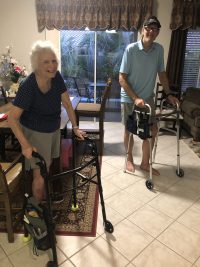
I have an elderly mom who does not adapt and conform easily.  She started this Coronavirus health crisis as a resident in an independent living facility for seniors.  Helping her understand why I could no longer visit, why meals were not being served in the dining room, and why her hairdresser was closed was a daily challenge.  Then she broke her hip.  Now she lives with me and Doug. 

Doug has also been nursing a painful hip.  For a couple of years, actually. His hip deterioration has been a gradual sort of thing. We finally saw his orthopedic surgeon early in March, before COVID-19 made the news.  He was put on a list for a total hip replacement. Then COVID became a household word.   What we thought would be surgery in a couple of weeks became a wait for surgery for months and months.  Finally, the surgery happened.  Pain medication and dementia…  I wasn’t prepared.   I think I will hold off telling you about that for another blog. 

Here is a sweet picture of Doug and Mom healing together.

My home life these days mostly rides on the merry-go-round of caregiving.  I care for Doug, who is, one day at a time, sadly progressing into the tragedy of dementia.  And I care for my 88-year-old mom, who isn’t aware of her many limitations and who doesn’t like to wear her hearing aids. I bounce around between cooking meals, giving directions, repeating myself, incontinence embarrassments, repeating myself, physical therapy appointments, laundry, and repeating myself.  The days when I laugh, get a hug (socially distanced, of course), see a friend (wearing a mask, of course), and drop a couple pieces into the 300-piece jigsaw puzzle being worked on the table are good days.  Those are the days that keep me balanced. 

Most of the time, I think I am pretty strong.  Most of the time, I think I can handle it. 

That is until I burst into tears because I forgot to bring the garbage can up the driveway and got a homeowners association ticket for leaving it out.  Or until the lady in the car on my left doesn’t put her blinker on as she crosses into my lane and forces me to slam on my brakes and lay on my horn. Or until I feel my pulse in my temples when I repeat the point three times more often than I really feel is necessary. Or until the frustration rises in my chest as I approach the front of the grocery store, notice the glaring masked faces staring at me, and realize I left my mask on the counter at home.

My family has noticed the reality of my waning strength.  They love me enough to step up and start talking about it.  They see past the inaccurate “I can do this by myself” perspective I wear like a medal around my neck.  They call.   They visit from afar.  They talk with me.  They talk without me.   They love…  

They convinced me to move us closer. 

It’s time.  I know it is time to be geographically closer to family.  It is time to share my caregiving experiences, responsibilities, and my people (Doug and Mom) with my close-knit family.  My son is not shy to remind me that today is the best day dementia will have. He’s right, you know.  He’s right about a lot of things. He’s even right that it is also time I build respite into what I am now starting to admit is a weary frame. 

Moving closer to family means moving about 1000 miles north of where we live now.  It will be moving back to very familiar territory. It has been home to us before.  It is home to most of our family.  Moving north will put us close enough that family can drop by unannounced (without a plane ticket) and be present whenever it feels like they need to be present.  I look forward to that.

But, in the light of complete transparency, as good as a move north promises respite, family presence, and the familiar, I am sad to leave this place Doug and I have called home for ten years.   I am sad to leave the place itself.  The sunshine.  The people.  The memories.  The friends.  Mostly the memories. 

Doug was healthy when we landed here and started a new thing.  We loved it together.  We made some beautiful friendships together and enjoyed the amazing landscape, outdoor adventures, and patio dining under the summer misters and the winter heaters.  Now I love it mostly by myself.

That said, I know how blessed I am to have a close-knit family who is willing to help me navigate through the dementia problem that does not have a favorable solution.  I realize the blessing of having siblings who want to share in problem-solving our only living parent’s old age, limitations, and dignity.  I embrace the blessing of having a family tribe that wants to be a tribe close in geography, regardless of the inevitable messy and new normal we will face together.  I am thankful every day for this.

You see, we really are in this together.  As a family, we have decided to adapt and conform together in geography and toil­­.  As a tribe, we have committed to navigating the waters before us no matter how difficult the journey becomes, regardless of what the new normal will look like, whether it is easy or hard. One-day-at-a-time.

So today, I go to Home Depot, adorn the mask, and pick up boxes and packing tape.  I donate things I have not used in far too long and rest in the love surrounding me.  The moving van pulls out in a little more than two weeks.

I am the lucky one.

Karen

A Matter of Trust

I remember being at a camp one summer as an adult and eeking out the courage to participate in a grand adventure.  The “High-Rope-Course”.  This was an obstacle course in the trees, high high, high up off the ground.  I was harnessed, wore a helmet, and was lifeline clipped onto the course.  The goal was to move through the obstacles (tight ropes, ladders, swings…) one right after the other and finish with a grand finale.  I confidently stepped, balanced, and tackled one obstacle after the other. 

I was puffed up and proud. I thought I had this high-rope course mastered.  I remember thinking, “What’s the big deal about this anyway?” (Except it was waaaay high in the trees, and looking down made me a bit nauseous).  But then… I arrived at the grand finale. 

The grand finale was a letdown in appearance.  There was no big “You’ve Arrived!” sign or “Congratulations, you made it this far!!” cheering squad.  Alas, just a small piece of wood, a tree, and a trapeze. 

To complete this test of trust and bravery, I had to stand on a small triangle block of wood attached to the trunk of a huge tree.  The piece of wood I balanced on was smaller in diameter than my feet were big. The grand finale, the grand poobah, of this high rope course required me to jump into thin air.  It required a lunge, a leap, a swipe, a crazy amount of bravery.  It required me to propel myself forward into nothingness and reach for a trapeze, about 6 feet out of my reach, that was supposedly going to carry me down to the ground with the final thrill of a zipline adventure.

This is when I fully understood the purpose of the harness, the helmet, and the lifeline attached.  This is when I thought I would throw up.  This was when I knew I was past my limits and probably going to die in the descent.  This is when trust and courage instantly vanished into distrust, fear, and tears.  I had a lump in my throat the size of Texas, but I pretended to have the courage of a lion.  Truthfully, I was choking back the tears of my 3-year-old self needing my mommy. 

I felt the tree in my back.  My body physically trembled. There was a spotter.  His name was Wayne. I met Wayne before I started this crazy charade.  He was over 6 feet tall, as strong as an ox, and had straight white teeth and a colorful tattoo on his left arm. Wayne was on the ground.  Waaay down there on the ground.  He looked like a sapling, about 2 feet tall, and his tattoo was indiscernible.  He held the other end of the lifeline.  He hollered up from the ground in a barely audible, lost in the distance between us, encouraging… “Yooou….caannn…. dooooo… iiiit…..” I thought I was going to faint.

My trust was challenged to its max.  I froze.  The leap was impossible for me.  There were too many variables.  What if I miss the trapeze?  What if Wayne was not as strong as I thought he was?  What if I get going too fast and crash into the ground with an explosion of dust and bones?  Is Doug a good enough father that he can raise the kids by himself? Do I have enough life insurance to cover this disaster? 

Nope.  I couldn’t do it.  I didn’t jump.  I had to be assisted off the block of wood.  I became the cowardly lion.  My puffed-up pride disappeared into thin air.  I suddenly lost all trust and confidence in pretty much everything and everyone on that high-rope course that day.  I wanted to have more control.  I needed to be sure.  I just. Could. Not. Jump.  

But… The good news is… I am alive to tell you about it!

Despite the assumptions you may have about the story I just told, most of the time, I trust easily.  Maybe too easily.  I believe people when they tell me their version of their own story.  Doug jokes that I would make a terrible CIA agent because I would believe both sides of the story equally.  I am not a very good juror.

Doug and I built our marriage around trust.  We worked at it.  We don’t have any secrets between us.  At least none that I know about.  When Doug told me he was on his way home from work, I could set the clock to it.  When he shared a happening he had experienced, I could have confidence in its occurrence.   When we would go here or there together, I trusted that I was well taken care of in his company, and so were our children. Trust has been a big deal for me in our marriage, for us.

I have often wondered if Doug was in Wayne’s place on the rope course that day if Doug was holding the other end of the lifeline, would I have jumped? 

It’s not that I don’t trust Doug anymore; it’s just different.  I can’t trust him in the same way.  I still trust that he loves me and that his love towards me is genuine.  I still trust that he wants to do his best.  I still trust that his heart beats for his family.  I still trust that he wants to care for me and be there for me.  

It’s just that trust + dementia in everyday life = craziness.

Doug says he took the garbage out, but the garbage remains full.  He says he ate lunch, but his lunch is still in the refrigerator.  He attempts to fix the toilet, but it is not broken (until he starts fixing it). Doug believes his kids all live here in the same town as we do, but that is not true either.  Is Doug a liar?  Far from it!  He just lives some of his days in an altered reality. 

His days vacillate between being spot on.  Knowing truth from fiction.  Doing projects that are very helpful.  He is able to complete his sentences, recognize the date and time, and not repeat questions or comments over and over.  To slipping at all those things and more.  To missing details.  To saying things are what they are not.  To complaining about pain, I am not sure he feels.  To even neglecting self-care.

I wrestle with trust.  With knowing what is real in his world.  I know his world is real to him 100% of the time, but it is not the same as my world anymore. 

My CIA and sleuth skills are being refined daily.  I am begrudgingly learning to question and look deeper at “real.”   I am gaining daily courage to handle things as they are and as they are becoming.  That to me, more and more, feels like preparing to be brave enough to jump off the small little platform I’m standing on into what some days feels like thin air.

Sometimes, it feels like Doug and I are locking arms and taking on dementia a bit like a grand adventure.  We keep loving each other and discovering “real” daily (which really can be an adventure). And we continue to push out into the uncomfortable unknown place of trusting others. 

But, in the times when our arms don’t feel locked in this grand adventure, when we feel alone and separate in this test of trust and bravery, I have promised Doug that I will continue to share our story and carry hope. I will let others care for us and keep trusting in God’s grace, provisions, and security for a safe landing.

Karen

Moving With Dementia

Growing up, I lived in the same house, neighborhood, and town from toddlerhood until moving into a college dorm.  I went to grade school, middle school (or junior high, as we called it back then), and high school with the same group of kids.  I attended Sunday school at Central Lutheran Church, had the same pediatrician all my young years, and lived next door to the Johnstons throughout my childhood.  I stopped for candy at the corner market while walking home from school.   My dad worked and my mom stayed home.  Dinner was served in the dining room, family style, every evening at 6 PM.  My dad passed away at 74 years old in the family home and my mom sold it after living there 52 years.

Life was familiar. Established. Proven.

By the time Doug and I met, in my second year of college, he had lived in numerous houses and several towns. His upbringing was markedly different than mine.  Since being married, we have lived in 16 houses and 6 towns.  Our children had a stable upbringing that included living in fixer-uppers and having for-sale signs in the yard.  A very different experience from mine.

Doug and I know how to pack boxes, hang pictures on the walls, and move furniture without a ding.  We are experienced “Uhaulers” both short and long distances.  We know how to clean and inspect houses both coming and going.  Mr. Fix-it was Doug’s nickname in my mind.  I knew he could fix anything.  That was our ace in the hole.  Sweat equity.  The worst house in the best neighborhood.  No project was too big or small.  Equity led the charge.  If the spreadsheet said to do it, then we did it.  The kids knew moving as an exciting new adventure. 

This month, we have made what I’m calling our final move (I hope…).  We packed, cleaned, Uhauled, hung pictures, and unpacked.  The new house is two blocks from the old house.  Same neighborhood, different street.  The reason we moved is complicated.  Moving with dementia is also complicated.

Making the decision to change addresses was my decision alone.  I discussed it with Doug like in the past, but his input regarding all the complications was minimal. Each time I brought up the relocating quandaries, he needed reminding that moving was on the horizon.  As the choices were made one by one and the move became a reality, Doug showed excitement and energy towards a new adventure.  I guess moving is in his DNA.  He’s done it a lot.  I think he likes new beginnings.  But I was concerned.  This time, Doug and I were moving with dementia.  Mr. Fix-it, in my mind, was a thing of the past, so I hired a handyman. 

Flexibility and change energized Doug.  Dementia, however, causes confusion and apprehension.  Doug now requires consistency and stability.  Not exactly the definition of “Relocate”.  So, I figured staying in the same familiar neighborhood might help even just a little.

I decided to take the move slowly, one day at a time.  Doug and I worked together to take things to the new house over three weeks, mostly in the evenings after I was home from work.  I decided to leave the furniture for the last.  I hired movers to help with that. 

Over the three weeks, Doug and I moved a room, a closet, or a cupboard at a time in the back seat of the car.  It required many trips and lots of repetitive patience on my part.  We took it slow, and when Doug showed signs of fatigue, confusion, or anxiety, we took a break, a breather, a time out.  It worked pretty well.  By the time the furniture arrived at the end of the three weeks, the rest of the house was mostly put together. Even the garage!  I knew where the spoons and forks were.  I could find a broom and a screwdriver, and I even found sheets to make up the beds.  But best of all, Doug accepted the new space as his new home with no trouble.

We are both adjusting well.  Doug likes the freshness of new.  He especially likes the recycling and trash bins in the kitchen.  We just got them (an early Christmas gift to us from us).  He can’t find the forks or spoons however, so I’m glad I know where they are.  The first couple of sleeps in the house, in the dark, were disorienting.  Nighttime can be that way with dementia.  Shadows tell stories, and darkness changes reality.  I bought some nightlights.  We are both sleeping better now.

Doug has a calm, gentle, settled demeanor going into this holiday season.  I am so grateful.  That was one of my many goals surrounding this move.  I am also grateful to be moved by Christmas and have Christmas music playing through the house.  Music has been an incredible stabilizing tool throughout this move.  We played it in the car, garage, and in both houses, coming and going.  Music and Doug have always been a team.  Music and Doug, with dementia, are nearly inseparable.  But that’s a different blog for a different day.

I am very thankful for this holiday season.  I am counting my blessings.  Last year, at this time, signs and symptoms were confusing and undiagnosed.  Next year at this time… I can’t even imagine.  So, I choose to take a deep breath, stay in the now, and be grateful… Very grateful. 

Merry Christmas, and may you enjoy God’s many blessings and feel His love in 2020, wherever it may take you.  One-day-at-a-time.

Karen

Arguing with Dementia

Pancakes.  More specifically, Doug’s grandma’s buttermilk pancakes from scratch and Krusteaz, just add water pancake mix from the bag. That was it. That is what started it.  Doug had an opinion. I threw the spatula, and our first argument, as a married couple, was underway.

I was raised in a home where gourmet was associated with a butler, an English accent, and a white lion-cut poodle with a pink bow.  Meals in my home were to eat, not display.  Simple was good, casseroles were expected, and leftovers were daily.  Breakfast was the fend-for-yourself meal, and buttermilk belonged on the farm.  When the Krusteaz pancake mix debuted on my childhood kitchen counter, the simplicity of just adding water made perfect sense. 

My mom and I did not spend much time together in the kitchen.  She did not share the family cooking secrets on Sundays.  Probably because there weren’t any to share, and she in no way was Martha Stewart.  Mom preferred bookkeeping and Junior League over homemaking.  I learned to cook and bake by watching the occasional mom moments in the kitchen and by trial and error, using Cream of Mushroom soup and the Easy Bake Oven. 

Doug came from a poorer family than I did.  He learned to eat fast and make things from scratch.  He loved to cook.  He enjoyed the flavors, colors, and presentation of food.  I couldn’t care less.  Before marriage, I had prewarned him that food was not my strong suit.  I knew how to make a chopped green salad (because I ate many of them) and toast was a good staple for breakfast.  He married me anyway.  So, when he compared the delicacies of my morning display of Krusteaz pancakes that I proudly placed before him maybe two weeks into our marriage to his grandmother’s famous buttermilk pancakes…  I lost it!  We argued hot and heavy over the considerations of pancake ingredients.  It ended with me in tears and him out for a walk.  Alone.

Looking back, it’s hilarious!  At the time, my feelings were hurt, and I stewed over it for a very. Long. Time.  Pancakes I made were not displayed on our breakfast table again until our middle child begged.  He was 5!  I used Krusteaz and added water.  Doug thanked me and ate them quietly.

Doug and I are two very different people, which might be the very reason marriage has worked for us all these years.  He has challenged me, and I have challenged him.  We have not always agreed on everything, and we have argued about many things, some that mattered and others that didn’t.  Occasionally, feelings were hurt, and almost always, bridges were built.

I am the more bullheaded of the two of us.  I see it the way I see it, and I think Doug should also see it that way. I pursue.  Doug is the gentler soul of the two of us.  He let me know when it mattered to him, but he mostly skillfully guided the outcome with calm words and patience.

I learned to pick my battles as marriage lengthened into years and the children grew.  I realized along the way that a lot just needed to be left alone and that only the important needed to be pursued.  Dementia has refined that even more.  I finally understand that arguing with dementia doesn’t work and, with dementia, very little, mostly nothing, ever needs to be pursued.  Dementia is not rational.  It skews persuasion, and it cannot manipulate outcomes.  This disease amputates the complexities required to do those things successfully.  Doug is slowly losing cognitive skills like logic, reasoning, problem-solving, and decision-making. 

As a result, I notice his ability to dialogue back and forth through an entire conversation is waning.  He loses track of the point, especially in a conversation with the edge of an argument.  For example, Doug might say something that I know is not accurate.  So, up until pretty recently, I would self-righteously charge into the exchange and correct him.  I would say, for example, “No, it’s not that, it’s this.”  Before, Doug would shoot back an opinion.  Now, he flusters to defend his position and becomes confused on the point somewhere along the way.  The whole exchange leaves him feeling defeated and me feeling like a predator. 

So, I no longer pursue it.  I just change the subject all together.  It is much easier and way more peaceful to let go of the hunt to be “right” and instead validate him and redirect the conversation.

I have a friend, John.  His wife has dementia. She has had it longer than Doug.  I reached out to John during the ping-pong process of Doug’s diagnosis.  That’s when John told me the best part of this disease is that his wife does not stay mad at him longer than 3 minutes, and they never argue anymore.  “What’s the point?” He asked rhetorically, “Neither of us wins, and the goal of the argument is not remembered long enough for emphasis.”  He ended our conversation by saying, “Honestly, Karen, our house is very peaceful, and we’re having the time of our lives.”

I appreciated John’s more than optimistic viewpoint and perspective on his home life with dementia, but I did not fully understand it.   At the time, I was a deer in the headlights, trying to fix my home life and somehow make dementia go away.  I was not having the time of my life, and I did not have peace…

Now, I do. 

Now I understand that because of the way dementia is gradually and methodically taking over the rooms of the frontal and temporal lobes of Doug’s brain, he would really struggle to think up ways to scheme or plot to “win” an argument or an outcome.  Those higher-functioning waves of reason and logic are steadily being silenced.  This does not mean he never has an opinion; he does.  But Doug finds it frustrating to argue for it and can be swayed from it.  

I’ve been told once… or twice, “Don’t sweat the small stuff.”  I’m not sure if it’s age, life experience, dementia, or some of all three responsible for ringing that loud and clear in my current daily pursuits.  Pancake ingredients would never make the cut at this stage of the game, and arguing with dementia is a complete waste of time.  Life is short.  “Peacefulness” and “the time of our lives” are now top on our home life agenda.  It’s not always easy, and it’s not usually my first impulse to redirect and validate.  But I’m getting better at it and seeking peace one day at a time.   

Karen

The Guy Tribe

To know Doug is to be a part of a clan.  His clan.  Doug has friends literally around the globe.  Partly because he has traveled and partly because he talks to anyone anywhere creating a new best friend before they part company.

I learned about Doug’s uncanny magnetism early in our friendship, before marriage, before dating.  In fact, I had to decide, as I got to know him and watched this magnetic clan phenomenon manifest, if I really wanted to be a part of such a movement.  I recall feeling intimidated by it, a bit awkward and insecure.  It was captivating to witness what Doug remembered and how he could engage just about anyone in a unique individual way.  I wondered what his secret was.  We’ve chuckled over the years about how he may have missed his calling as a CIA agent or a representative of the Special Intelligence Service.

A typical encounter would include Doug using his friend’s name in the greeting and then gently transitioning into asking a question of concern, revealing a memory they both shared or could relate to, and chatting about a current event topic as if no time had passed between them. In the early days, I recall being so taken aback by this “smooth transition” skill he possessed.  When Doug would introduce me into the exchange, I would bumble around with my manners.  I would extend my hand for a handshake and feel the flush in my cheeks as I had already forgotten Doug’s friend’s name.  I would say “hello” and leave it at that.  I guess opposites attract.

Just the other day, we were walking through a crowded mall, and Doug said to me, “Do you see that man up there in front of us walking with that woman? I think that is Sterling and Wanda.” I was scrambling to remember the last time we saw Sterling and Wanda… three years ago…maybe four. And it’s not like they were close friends we saw frequently and spent extended time with. Doug, who has Frontotemporal Dementia, is looking at a couple from the back, walking through a crowded mall environment, and thinks he recognizes two people who are friendly acquaintances at best.  My response was tactful, like, “Are you kidding me? Why do you think that is them?  There’s no way… How do you know what the back of their heads looks like?  It’s not like you can see their faces…” Doug would have none of it.  He sped up his walk, left me behind, and called out, “Sterling??” I wanted to wilt into the crowd.

“Here we go,” I thought as I picked up my gait to rescue Doug from himself. “My husband, with dementia, has started to think he knows everyone in a crowd and will walk up to any random stranger and start a conversation, calling them by some random name… and then”, my thoughts continued, “I will have to go up to these poor random people who have become his victims of embarrassment and apologize for his… randomness and become embarrassed myself and…”

By the time I reached Doug, he was shaking hands and already in conversation.  I felt the dread of an embarrassed apology rise in my chest. 

But guess what?

IT WAS THEM!

The two people, strolling through a crowded mall on a Saturday, weren’t random at all!  They were Sterling and Wanda!  I was dumbfounded. Shocked.  Flabbergasted.  The four of us stood there between Victoria Secret and Hollister and got reacquainted.  Sterling told us that Doug and I have been in their prayers.  They knew about his dementia diagnosis.  We laughed about Doug’s uncanny way of recognizing a face (or a haircut from the back). 

This crazy experience certainly doesn’t reflect what most of us think dementia should look like.  But it does reveal Doug.  It demonstrates what he loves most.  What matters to him most.  People and relationships.

After we parted company with Sterling and Wanda, I asked Doug, “How do you do that?  How did you know it was them?”  He answered, “I never forget a face.”  I wanted to remind him that he never saw their faces before he stopped them… just the backs of their heads… But I thought better of it and left well enough alone. 

Doug has what I fondly call his guy tribe.  He has always had good friends, but since the diagnosis, these guy friends (including family members) have really stepped up.  Some live close, and some live far away.  They are all men, and they have all committed to walking this dementia journey with Doug, wherever it takes them.  They give him rides, call him on the phone, go golfing, fly to town to see him, play pool, enjoy a good cup of coffee, share experiences, pray for him, laugh, tell the truth, and do guy stuff.  But mostly, they care for Doug, and by caring for Doug, they care for me.  These guys let Doug be who he is on any given day, and honestly, some days are better than others. 

With these guys, the smooth conversational transitions I came to expect in Doug’s relationships aren’t necessary, which is a relief.  Frontotemporal Dementia has interrupted his suave way.  Now, because of the speech variant side of this disease, Doug’s effortless, captivating exchanges have sometimes become disrupted by silence, word searches, and lack of recall.  It is now more common to experience bumpy, uneven transitions in conversation.   In fact, one of the early dementia warning signs I noticed (and unwittingly dismissed) was these potholed jolts in the dialogue between Doug and his friends.  I overlooked these signs, justifying them as this or that.  I realize now that it was easier to blame random possibilities for behavior change than to consider the seriousness of what these symptoms might actually have meant.  

Doug’s guy tribe friends graciously answer the same question more than once when Doug unknowingly asks more than once.  I’ve watched some of them patiently wait when Doug’s having a moment, as he gathers his words to make his point, or when he repeats the same story or opinion he has already made.  I’ve seen them laugh together, talk about serious topics, not talk at all, and share grace.

Over the years, I have heard people refer to Doug as their best friend, second father, brother, pastor, buddy, comrade, ally, supporter, leader… I could go on.  Doug genuinely likes people.  Relationships and people matter most to him, and he is a true friend to many.  If you know him, you are the lucky one.

Thanks guys!

Karen