
Those of you who know me know I am extroverted, and I like to talk. My primary school teachers and the principal knew that fact without question. So did my high school swim coach, my best friends, and my dad. Words are, and always have been, my engine. They fuel me. They guide and direct like a compass. My career choices have leaned heavily on language – writing, public speaking, lecturing, instructing, one-on-one dialogue. I even have a master’s degree in communication and leadership!
So, words are my thing.
Some people would say music is their thing, or painting is their thing, or technology, astrology or economics, or dance is their thing. This thing is the thing that helps make your world go around. It communicates to you and through you. It has probably been your thing since day go. I like to talk and listen and dialogue back and forth. I also like to read and write (hence this blog) and expand my vocabulary. Words give me the leverage I need to solve a problem or direct the traffic of my life.
The use of words can calm me down, like when I read a bedtime story to my grandkids or listen to meditation with headphones, or they can energize me like when I meet a friend for tea and have more to say than I have time.
Doug found pleasure in teasing me about needing to “use up my words”. When the children were young and I spent more hours serving small toddlers than I did interacting with the world, Doug would come home from work and be barraged by my daily unspoken – turned verbal – thoughts. He heard everything from what the kids did throughout the day to my opinion about world events. Doug learned very early in our relationship that it was easier to nod and give an occasional “uh-huh” now and then as I spewed the plethora of my thoughts than to have any opinion at all about any of my musings. His listening and my talking fortified me.
Doug’s opinions came later.
He let me talk and talk and talk, and then, when the timing was right (which was often on a different day), he would revisit my words, remind me about what I said, and then give his opinion. I valued his opinions (most of the time).
Doug would think and then speak. He was often funny, sometimes right, sometimes wrong, and commonly gentle in his interpretation of my oration. I came to appreciate his usually well-thought-out delayed feedback and conversation.
The track star, Jesse Owens, says, “If we walk long enough and talk long enough, we might come to understand one another.” I just love this quote and believe it wholeheartedly.
Doug and I used to walk the river trail. It was a beautiful long nature trail with stunning river and canyon views behind our house, where we raised our kids to be adults. The two of us would walk together and talk together and come to understand each other on this trail. We talked about everything we cared about. We discussed whatever was top of mind at the time and whatever needed to be considered. We laughed sometimes, and we cried sometimes. We decided things on those walks. Basic things like which toys went under the Christmas tree. Things that mattered more, like the best college for our graduating senior. Even the really tough things like the optimal time to sell our memory-filled family home. On that river trail, I learned, I talked, I listened, I trusted, I ached, I argued, and I grew up. Those walks and talks are now some of my most precious marriage memories. Sigh.
Dementia, more specifically Frontotemporal Dementia, more specifically still Primary Progressive Aphasia, is chipping away at Doug’s language faculties. His ability to follow and understand language, formulate words, ideas, and opinions, and his ability to express, using the limited language skill he still retains, is steadily becoming silenced. He spends much of his day quiet.
Of course, I still use up my words on his ears. It’s my thing after all. But more importantly, it is my one-dimensional way to attempt connection; to try to coax him out of his silence. My daily discourse is my genuine attempt at igniting hope; just maybe, his gaze will meet mine, and his opinion will be expressed boldly and without reservation, with no confusing words, mixed-up sentences, and halting patterns, or single-word speeches. Sadly, however, the once-upon-a-time exchange I well remember and hope for, the two-way conversation and dialogue I covet, has not happened in a long time.
Doug and I go to Speech Therapy together. His speech therapist is good at drawing words out of him and making me quiet. She is patient and tricky. With her guidance, I am developing a notebook of words, pictures of family, places, objects, and lots of stuff that will perhaps stir recollection and unite sentences. I also use a whiteboard with erasable markers to jot down words. I ask him, “Would you like tuna or ham or veggies?” I write Tuna, Ham, and Veggies on the whiteboard. Seeing the words makes it easier for him to pick. It’s harder for me, more work, I mean. It’s easier to just give him something to eat. Being a good sport can be tiring for both of us.

I wonder what he is thinking; what he comprehends, if I talk too fast or say too many words to follow, if he wants to say something but can’t find words or finds it too cumbersome to try. The whiteboard slows me down and gives him word choices. It helps.
Undesired silence is deafening in its volume, decapitating choice. When I am craving Doug’s unique opinion – lying down next to him at bedtime, where we used to dissect the day together, or deciding on something alone, I wish he was deciding on with me or for me – the stifling clutch of silence booms and often lingers.
Sometimes, to break the domineering silence, I turn on music, usually quiet in the background of my day. It breaks up the monotony of my thoughts and occasionally detonates Doug’s voice in song. He may sing a lick or two with little or no language deficit if the song is familiar. He has always sung beautifully. But now, hearing his voice – the tone, the unique edge of his sound – can sometimes startle me with uninvited watery eyes and a lump in my throat.
Doug rarely appears frustrated in his silence. If I were him and had to manage all the word chaos, I assume he is navigating in his head every time he goes to say something, I would be very frustrated. It is almost as if he doesn’t recognize silence is happening. Sometimes, he participates in surface three or four-word chit-chat, usually initiated by someone else, and sometimes, he speaks sentences that have a point, albeit elusive. When I listen as he wrangles with sentences, trying to nail down a point, I get exhausted in my efforts to follow along, like how I imagine herding cats would make me feel.
Little children like short sentences and chit-chat too. Our granddaughter mimics her mom with phone-like chit-chat and voice fluctuations that adults use when talking to friends. It is very cute. Doug identifies with her language. He has short, sweet conversations with her using her size words. Doug also talks with an adult friend on the phone. They laugh. Bruce (his phone friend who used to be his in-person friend, but then we moved 1100 miles away) understands short, sweet, uncomplicated, dementia pacing (if that’s a thing) chit-chat. Doug smiles and feels successful after tele-talks with Bruce. I smile too. Thank you, Bruce.
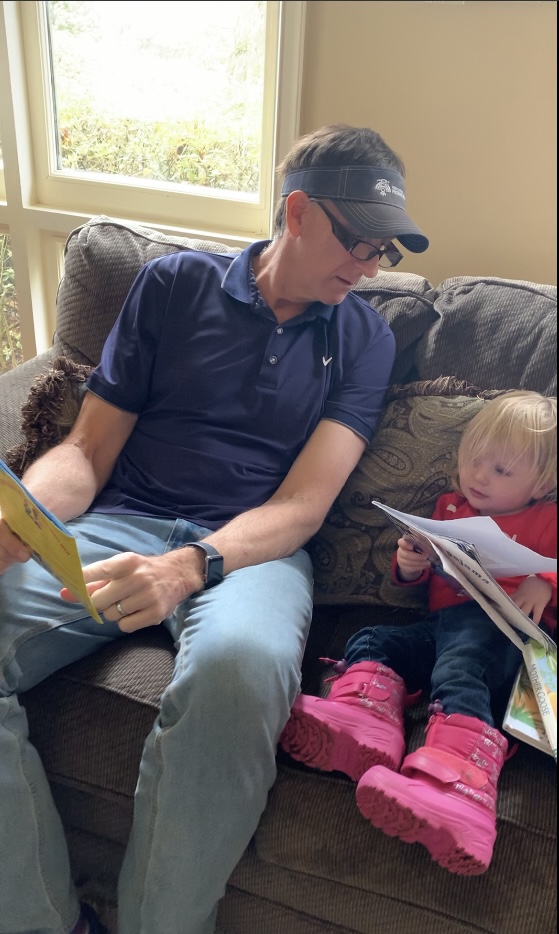
Mostly, though, Doug is just peacefully quiet. His peacefulness is the beautiful hidden blessing in the brutality of his dementia. We are lucky for that.
I am also lucky God is a good listener. He often endures my word outpourings, equal in volume to the summer monsoon rains of Arizona. I think he can handle it. God clearly understands how words are my thing. He made me that way. Graciously, he never interrupts, never chastens me for my many verbal protests about how it is hard and how I wish things were different as I bemoan the slow-motion tragedy of dementia unfolding before me, and he never tells me to quiet down or sends me to the principal’s office. Instead, he brings balance; he gives me courage fresh every morning, unconditional love, and the patience required to be a good sport. God knows I need that. God knows Doug needs that.
And deeply, I am grateful for that every day, one day at a time.
Karen
 As it is in Heaven