Vacation

Doug and I loved to take vacations with our kids.  We would dream about the adventure, plan it in advance (most of the time), save our pennies, and execute the escape with lists, agendas, and a camera.  Doug was the dreamer, the executor, and the photographer.  I was the saver, the list maker, and the agenda keeper.  Doug brought the fun.  I brought the order.

Over the years, we enjoyed camping and adventuring in assorted environments.  There was a densely wooded back road with a cliff to a steep canyon below and a flat tire.  There was a bike trip in August in the worst rain on record.  A sailboat and thick fog were responsible for nearly running us aground.  There were sunburns and near frostbite. There was the moped, a wedding or two or three, snow, learning to ski, Hawaii, sunscreen, family, Disneyland, a lake house with a ski boat, beaches, a cruise, cross-country treks, and getaways close to home. Adventure and opportunity were the name of the game, and Doug was the master at making the experience exciting.

In his very spontaneous, unrehearsed, creative way, Doug crafted memories.  Vacations were the platform he used to design what he knew would be celebrated later.  He delighted in the story that would be told as our kids grew and as they became parents themselves. 

With the kids now grown and a second generation exponentially expanding our family, making memories and vacationing feels even more significant. The precious framed memories populating our walls illustrate how excursions are essential and shared experiences. They are the exclamation point.  We now clearly realize the merciless cadence of time never slows down.  It gives birth to gray hair, grandbabies, and forgetfulness.

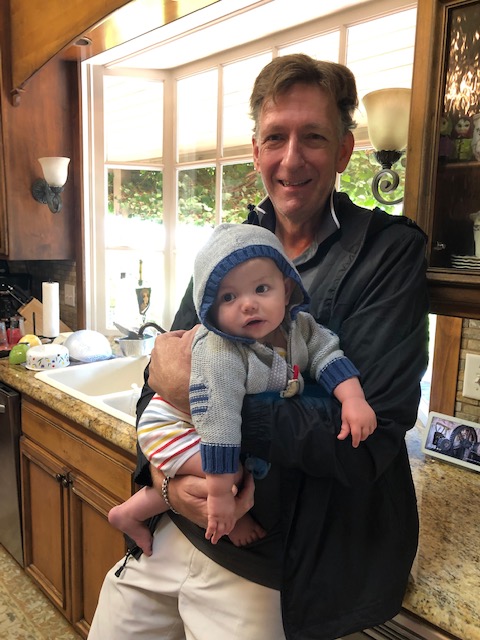
So… with dementia in tow, my hair dye covering the gray, and a new grandbaby to meet, We (mostly me) planned, saved, charged the camera (iPhone), and… went on vacation.

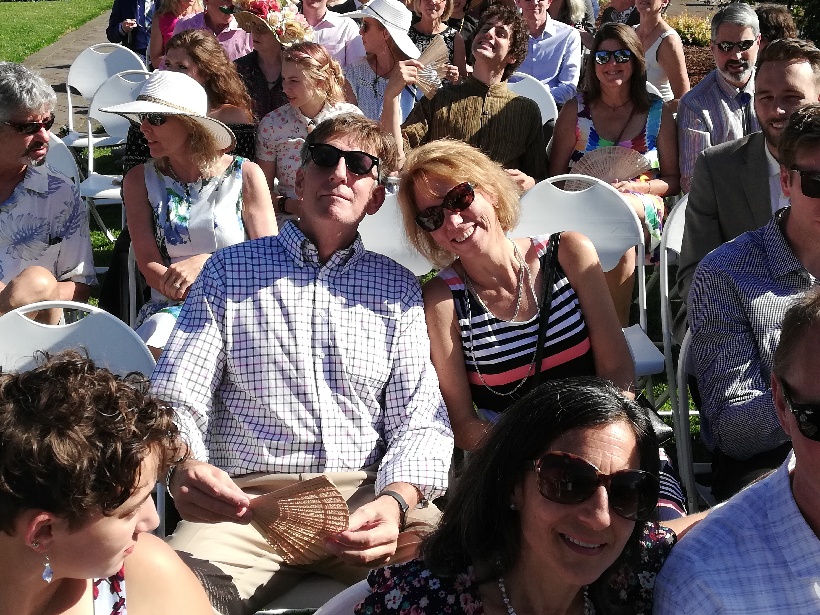
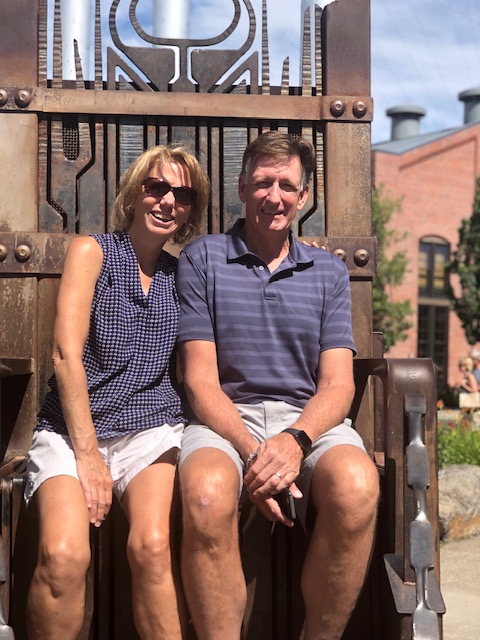
The trip reunited us with our children, extended family, and many friends. Doug and I traveled over 3000 miles by pickup truck to a family wedding, a lake house, our previous hometown, airports, our son’s house, and a bunch of menus and mattresses.  It was a trip for the books filled with memories, shared experiences, an agenda of precise detail that Doug carried in his pocket and referred to frequently, and many pictures! It was so much fun!

Leading up to the execution of this vacation was markedly different from the ones we’d taken in the past.  I was in charge of the list and agenda like before, but I was also in charge of everything else: the fun, the photography, the money, the accommodations, and, let’s not forget, the packing.  As we repeatedly opened and closed our suitcases during the two-week trip, Doug said, “Wow, I packed way too much stuff.” What he failed to realize was he did not pack.  I did.  The totality of his packing job included a coat, a pair of shorts, and some socks. I hijacked his sparse packing attempt before we left and filled his suitcase with “way too much stuff,” especially shoes.  But, who cares, we were traveling in a pickup truck! 

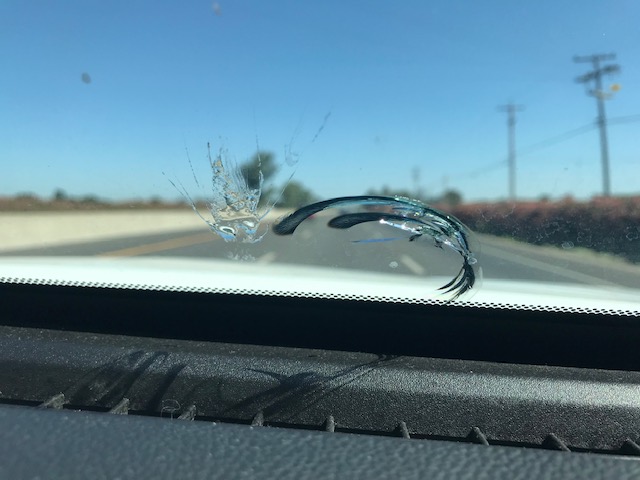
I was also in charge of driving.  Driving is my preferred position in any vehicle.  I easily get carsick as a passenger.  But driving solo 3000+ miles is a lot.  When the passenger side windshield broke on day two of our adventure due to a flying thing, I felt the burden of sole responsibility.  The impact crack was so loud that it took a few miles for me to regain my heartbeat.  I didn’t pull over.  It wasn’t immediately necessary…  Instead, it became necessary to assure Doug, on the verge of fretfulness, that we were fine and the truck was fine.  Just the windshield needed repair.  No big deal…  I figured keeping my cool and driving on was the best way to do that type of convincing… Whew!

This vacation also delivered some unplanned dementia education.  I learned, for example, that Doug now likes and needs order.  He used to be impressively spontaneous, almost to a fault (of course, that opinion comes from the one who lives with lists, agendas, and beeping reminders on my cell phone).  On our trip, Doug frequently wanted to know what was next, when we would get there, and what we would do when we arrived.  So I armed him with what became a well-worn, deeply creased, faded, hand-written agenda.  And I satisfied him with my tedious answers to his repetitive questions, “Where are we? When will we get there?  Who are we going to see next?” As long as I stayed patient and on schedule, he did well, and we had a good time.

Nighttime was the most challenging in the many different sleeping quarters we visited.  Each accommodation was laid out differently, and we did not stay in any single place long enough to become familiar.  The bed was over there instead of over here.  We turned left out of the elevator instead of right, like the night before.  The temperature control was here, there, and everywhere. But the most challenging was the location of the bathroom.  The darkness, the shadows, and the unfamiliar territory made getting to and fro in the middle of the night very disorienting. Truth be told, a dark, unfamiliar space can be challenging for any of us in the middle of the night, but add dementia, and it becomes nearly impossible.  Each night, well into my slumber, I would wake to Doug clunking around the room, lost in his quest to find relief.  I would help him find the bathroom and return to bed each night.  Surprisingly, even with this nightly ritual of interruption, we both felt like we rested well.  I guess that’s what being on vacation is all about.

Now, we are safely home from our grand adventure.  We are unpacked, with the “way too many” shoes put away, the truck washed, and the windshield repaired. The photos we came away with are the exclamation point.  For Doug, the memories of trip details are a bit fussy, so we enjoy vacation reflection through the many pictures we took. 

Frontal Temporal Dementia changed our vacationing patterns a lot.  It was apparent often and interrupted in many instances.  But FTD did not control our time together.  It did not land center stage.  Someday, I realize it might.  But this time, it didn’t, partially because we did not let it. The two of us laughed, chatted, sat in silence, saw many family and friends, reviewed the agenda again and again, and completely enjoyed each other’s company despite dementia.  We played hard, and we rested well.

This vacation will go in the books as one of the best.  As the merciless cadence of time continues to grow our gray hair and expand the shadow of dementia in our family, Doug and I will be forever grateful we made the time and took the time to go on this vacation.

Karen and Doug

A Stroke of Change

I write this tired.  Fatigued really.  That deep inside hollow feeling you get when sleep has been short, and demands have been high. This weariness has been my companion since early this month.  It is now three weeks in.  I am ready to feel rested and relieved.

I have lived long enough to know that life can be a roller coaster with ups and downs, beauty and ashes, happy and sad, big and small, achievements and disappointments, puppies and snakes.   I gratefully know that eventually, rest follows the weary, hope returns to the downhearted, and promise encourages new beginnings.  I also know that not all things are as they appear.  Some things are better than they look on the outside once you wiggle in and get a glimpse.  Some other things, unfortunately, are just plain shoddy, even if they glitter.   That’s life. 

I received a call of distress a couple weeks ago from my 86-year-old mom, who lived independently in her home two blocks from me.  She wasn’t feeling right.  She asked me to come.  I went.  Doug came with me.  It was clear that her issues were beyond my limited abilities.  I called 9-1-1.  Mom had a stroke.  She went to the ER and was admitted to the hospital.  She will recover, possibly with limitations, possibly completely.  Mom is now in an assisted living home, where she will spend time gaining strength back, meeting new friends, and working hard to gain independence once more.

Doug’s least favorite place to visit on any given day has always been the hospital.  His second least favorite place to visit is an assisted living facility. 

Early in our relationship, I learned that injury or sickness and Doug do not mix.  Raising kids landed us in the emergency room every so often.  Kids just do stuff, and sometimes, medical intervention becomes necessary.  We experienced a broken arm (actually two on two different boys), stitches, ear infections, surgeries…  Each time, Doug was little to no help.  In fact, when I was delivering our first child, the nurse brought him a chair.  They thought he was going to faint! 

The last few weeks have been challenging for him.  Doug has visited Mom (Grammy, as he fondly calls her) in a hospital, in a rehabilitation hospital, and in an assisted living facility.  All places he avoids on purpose.  Doug is used to visiting Mom healthy in her home.  His routine has been to stop by her house after his swim, before lunch, to say hi.  Routine for someone with dementia is important.  Routine has been key for Doug. 

I honestly didn’t think much about going to all those clinical places, with Doug at my side, after Mom’s stroke.  I was just doing what was necessary to care for her.  But Doug personalized it.  He saw himself there.

Shaking me out of sleep the other night, Doug said he needed to talk.  I glanced at the clock.  It was 2:00AM.  I listened as he expressed fear about being “put somewhere” late in the dementia disease.  Being put in a place where he had no control, in a wheelchair, in a corner, with nobody visiting.  He said it was his greatest fear. 

I felt like I had been gut-punched.  I felt guilt wave over me for being insensitive to what he might be feeling as we went from room to room and facility to facility with Mom.  These clinical places have many wheelchairs and even more lonely-looking sick people.

Please understand I do not write this so you will respond with kind platitudes about how I shouldn’t feel bad… my mom had needs… I’m doing the best I can… Thank you for that and all. I do appreciate the kindness, and honestly, I realize the truth in all those words.  But hearing Doug painfully fear his fate, however exaggerated or influenced by the late-night darkness, made my chest hurt and reminded me that dementia can quietly sneak up and then pounce with open claws like a lion.

You and I, without FTD dementia, can categorize and rationalize change and its effects in our amazing computerized layered minds.  We realize how time, like the difference between yesterday, today, and tomorrow, last week, this week, and next week, works.  We understand illness recovery and doctor versus patient relationships and how long recuperation can take.   We can distinguish between this hospital and that rehab hospital and what each building is specifically for.  These are all things Doug now struggles with, and they all play their part in making navigation through Mom’s stroke particularly haunting for him.

Sometimes I forget, briefly, I admit, but I forget just the same that Doug’s brain is changing.  I talk to him like it’s not.  I do my girl chat thing and share more details than he probably wants to hear.  I tell him about my day and mom, what I’ve heard from the kids, and what good or crazy things happened at work.  He looks at me like always, with his kind, engaged eyes as I carry on with all my voice inflection and inserted details.  It’s when I pause to take a breath or begin a new subject that I’m reminded.

A question usually triggers the reminder that Doug’s brain is changing.  Recently, the questions have been about mom.  He’ll ask, “How is Grammy doing today?” After I have just given an entire discourse on her well-being.  I used to think these poorly timed inquiries resulted from him not listening or paying attention, but now I understand they result from him not processing.   I talk anyway and answer the questions as often as he asks them. 

Doug and I are grateful that God is in the details.  I believe God knows the change we are navigating through.  He sees Mom’s left side, Doug’s brain, and my fatigue.  We feel the Lords peace, a peace that passes understanding, even amidst the stormy passage we’re in.   Mom is improving each day, and Doug still wants to see her, so I take him. 

I am certain God will be faithful to restore rest to my weary bones, hope when I feel downhearted, and promise for new beginnings. One-day-at-a-time.

Doug and Karen

The Protector

Because of where we live and who we have as health insurance providers, we may travel some to see a doctor of choice.  That was true on Monday.  We traveled by car, and because of traffic and the time of the appointment, it took about two hours to reach the neurologist’s office.  It was worth it.

The appointment hung heavy on the calendar for two months.  As it approached, I felt my tension rise.  I have taken on a new role, a role reversal, really, in my relationship with Doug.  I have become the protector.

I am not ignorant of this role.  I proudly held this responsibility as a parent.  I rallied for my daughter against the school bullies who strutted their stuff and sashayed against the school rules with pride.  I protected my son against the two neighbor dogs rushing at us from their side yard, with teeth gnashing and guttural rolling growls.  I confronted the boy who stole my son’s bike.  We found it in the boy’s front yard, and I was compelled to threaten 9-1-1 and ring the doorbell to inform the family we were taking it back.  We took it back.

But when it comes to me and Doug, he has always been my protector.  For example, I hate bugs. (I know it is really dumb, and I should get over it, but…)  Anything that crawls, I shriek.  I cannot even watch the amazing mystery of God’s bug creation on the Planet Earth TV show.  When the bugs appear, I disappear.  Doug has always stepped in like Superman and assured me I would be fine as he sweeps the cricket, the spider, the bee, or the crawly buzzy whatever outside. 

Doug has been my guardian and defender through tough and not-so-tough things.  His street smarts, quick thinking, dialogue, and athleticism could assist in getting us out of any sticky situation or just back to the car in a crowded parking lot.  His internal GPS got us unlost in Spain, London, and Weed, California.  His ability to talk to any stranger has introduced us to new friends, brought us to places to spend the night, and assisted us in catching rapidly departing flights.  His protection when I had cancer got me through it.

Now, I am protecting him.

I prepare his weekly routine.  For instance, I may schedule a golf round with friends he trusts, arrange lunch with our daughter and grandkids, and encourage a few swims at the community pool.  I take him as a passenger here and there because letting him drive would not be protecting him.  With his permission, I share how he is doing with his friends (and on this blog) so friends will understand his needs when they are with him.  I lead the way on hikes through crowded places and across unfamiliar territory.  I frequently order for him at a restaurant and always pay the bill.  I also take him to the doctor.

Through the course of Doug’s dementia, doctor appointments have typically not gone well. The doctors have all been nice enough and have done their job well.  Mostly, they have had a good “bedside manner” and have been friendly.  But they have consistently run many tests that have stressed Doug out and left me picking up the pieces.  I was not looking forward to this again.  I spent time considering (mostly while driving my car alone in silence) how I would protect him and myself from that happening again at this next neurologist appointment.  I had no answer.  I felt abandoned.

We arrived early to the appointment.  We were escorted quickly to an exam room, and then we were left to wait.  The clinical environment of an exam room is not our favorite place to hang out.  Doug and I would both greatly prefer the sounds, smells, and sights of nature on a hiking trail, with a peaceful, clear stream bubbling along and birds chirping in the trees on a sunny day, than the sounds, smells, and sights of the hygienic, echoing, white-walled doctors office. 

I could feel Doug’s anxiety building the longer we waited.  I had my protector hat on.  I was also tense.  Every time we heard someone in the hallway pass our closed exam room door, we both abruptly stopped small talk and looked, with anticipation, at the door handle to see if someone was coming in. This was not creating a calming energy.

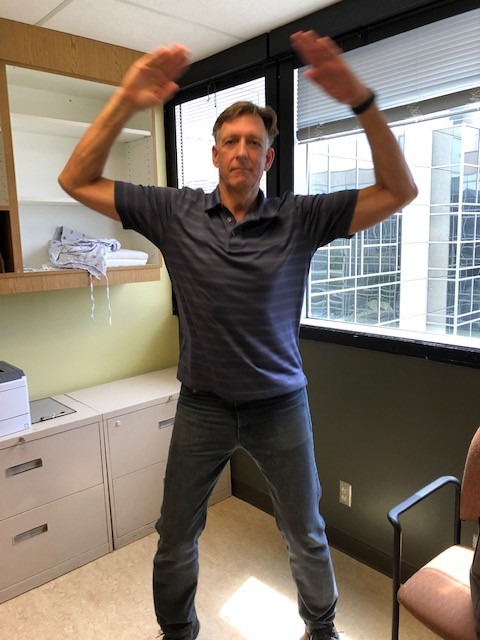
Typically, when Doug has anxiety progression, we put on our tennis shoes and take a walk.  It works almost every time to reduce the tension and bring calm.  Our tennis shoes were on, but we were on the 5th floor, a long way from the front door.  So, instead, we got busy doing calisthenics (wall push-ups, squats, flutter kicking…). We forgot about the sounds in the hallway, and we got the giggles.  The doctor walked in when Doug was doing jumping jacks.  I think he was a bit shocked.  We all laughed. 

There were no tests this time, just talk.  Doug left the appointment feeling heard and respected, not judged by a diagnosis.  We decided against medication for now.  An MRI and an MRA were recommended.

As a protector, I felt like I gained an ally in the doctor and relaxed.  I now realize that even though it is true that our role reversal is real and that I am not used to it, and I’m a little miffed by its requirement, it is not fully bad. It just is.  I don’t have to go it alone.  I have not been abandoned.  In fact, quite the opposite.  There are many more allies in this function of protector than I appreciated.  Now I am starting to recognize them: doctors, family, friends, you, even good-will strangers.  Doug and I know how blessed we are.  We feel well taken care of and are learning to appreciate and value our allies greatly. 

Doug and Karen

Normal

What is normal exactly?  When you think someone or something is normal, what do you mean?  Is normal when whatever or whoever looks or acts like you expect?  Or is it when who or what behaves appropriately?  Is normal when someone simply says it’s normal or when research proves it’s normal? 

Doug says, “Normal is the setting on a refrigerator”.  He’s right you know.

I remember the challenges I felt in middle school (it was called Junior High when I was enrolled), trying to fit in with my peers and conform to the ever-fluctuating young teen standard. My goal was to be normal.  If I was normal, I thought I would be liked.   I dressed and behaved just so, looked in the mirror way to often, and hoped, worried and anguished over receiving the acceptance and approval of my peers.  I struggled tirelessly to be normal, to not stand out, be weird, peculiar or unusual in any way. 

The early teen judgement was palatable.  The prejudice was painful.  The sharpness left its mark.

Then came high school.  The pimples lessened.  My hair was “right” for the current style.  I became more comfortable in my skin and I found what I loved.  What I thought my peers thought of me became less important year by year.  My self-confidence grew and insecurity died down. Laughter matured.  Friendships deepened.  Knowledge expanded.

Then came social media.  The expectation of “normal” hit a new plateau.  Many social media users are obsessed with the perception of the perfect life.  The perfect family, the perfect smile, the perfect job, dog, cat, vacation, dinner plate…  I have read studies and heard and even felt at times, as I am sure you have as well, that the perfect everything perception of the social media influence intensifies peer pressure and alters the standardization of the moving target of normal.  It’s like junior high all over again, but on steroids.  It’s computerized.  Face-to-face is no longer a requirement to feeling the insecure, embarrassed and fearful emotions of fitting in.

Illness of any kind can be off-putting with regard to normative standards and fitting in, especially when the illness is not understood.  When I was battling cancer for instance, I experienced both the shun and embrace of humanity.  As my appearance changed with treatment – hair loss, weight loss, energy loss – I no longer fit the norms I had created in my life. I wasn’t as bubbly and jovial.  My selfies looked tired.  I talked out loud about things like death and Jesus.  I ate organic vegan foods, herbs and drank green tea, and I wore a face mask, a head scarf and un-ironed cotton in public.  All of this made some of my peers, who knew me before, fidgety, nervous, tense. 

The normative standards affected way more than the way I was treated by others when I had cancer, it also affected the way other cancer patients saw themselves through the disease.  It was often heartbreaking.  I spoke to people who were embarrassed they had cancer.  They were ashamed by the physical changes in their body.  They did not want family or friends to know.  They lived in secret.  Accepting help was arduous for them. They absolutely did not want their picture taken.  They did not want to die, but they were unsure how to live.  Surprisingly, this was not true for just one or two people.  I met many.

Now I am meeting these types again, but on a new front.

Mental illness, specifically dementia, is shrouded in stigma. It makes cancer feel like a walk in the park.  Normal is slippery and evasive.  Awkwardness takes center stage.  Secrets are almost required, and shame is a noticeable bully.

Hence this blog.

I spoke with a woman the other day who knows a couple struggling through Alzheimer’s.  She told me it’s a secret.  That I shouldn’t say anything.  They don’t want anyone to know.  I wondered how long they will be able to hide it. 

In our household, hiding it would be impossible.  Doug does not have Alzheimer’s, he has Fronto-temporal Dementia.  Different yet similar.  Both dementias.  He repeats stories, asks the same questions over and over, tangles his words on his tongue, and doesn’t drive.  He struggles to plug in his cell phone, confuses directions past the first layer, and wonders if the shadows in his periphery are real.  I think we are past the stage of hiding it.  But, more importantly, why would we want to?

The need to fit in, to belong, to be normal, is powerful.  So much so that in the quest to blend in, we often hide what’s real.  The crazy thing is, when we hide what’s real, we are alienating ourselves from others.  I am not super old, but I am old enough to know that doing life alone, hiding the actual, authentic, real stuff, is brutal and very isolating.  I would rather risk embarrassment and then actively participate in finding a new friendship group. 

I learned early in life that normal can be altered.  If it is true that normal can be altered, then it is also true that an exact delineation of normal cannot be sustained.  In other words, your normal and my normal may be and can be very different and fluctuate. 

For sure dementia is scary and definitely outside the social media rendering of perfectly acceptable.  Sometimes Doug does not behave like he used to.  We never know how today or the next moment is going to go.  As a couple, we are spending time with friends and making new friends who understand (or are willing to deal with) the idiosyncrasies of our new normal.  We are also talking about it. 

Doug, has many times over the years, reminded me of the dichotomy of normal acceptability by sharing this adage.  Two men given the same task. One man says he can, and the other man says he cannot.  “Who’s right?” Doug asks,  “They both are.” He says, as he leans back into his point.  “It’s all in the way you see it”.

Doug and Karen

Driving

My mom started driving when she was 12 years old.  She is 86.  She is still driving… (That’s a different blog for a different day).  I started driving when I was 15.  Learning to drive with my dad was intense.  He was an uptight passenger, complete with sound effects and unnecessary body stiffness. Mom taught me to drive.

Doug started driving when he was 15, but he drove before that, probably without permission.  Doug and I grew up in a town that allowed licensed drivers to be 16 years old.  On Doug’s 16th birthday his dad tossed him the keys to the 1974 Datsun stick-shift pickup truck and told him to drive himself (solo) to the DMV and take the driver’s test, which he did, and passed.

When I was a young driver, learning the rules of the road, with my dad as the passenger, I was keenly aware that driving required multiple steps. Each of which could be easily overlooked causing dad to dramatically act as though the break and the wheel were on his side of the car.

I had to remember to press on the gas, but not too hard. Pull out into the lane, but first put on the blinker and look over my shoulder (something about a blind spot) to check for other cars.  Turn the wheel gently, but don’t over correct.  Use my right foot on both the gas and the break but be gentle to avoid giving my passenger father whiplash. I had to watch for construction, pedestrians, school zones, street cleaners, on ramps, crosswalks, speed limits…

Driving has many rules and lots of layered complication.  It is a wonder any of us learn to drive at all…  Especially at 16 years old!

I am sure we all have driving stories.  Scary ones, funny ones, ones that include law enforcement and ones that don’t. My first car was a 1979 yellow and black Volkswagen Beatle.  It was the car I inherited when Doug and I married. Doug was fluent in car ownership.  Before that wedding day perk, I had my driver’s license, but I never owned my own car.  I sometimes borrowed my parent’s car.  I occasionally borrowed a friend’s car, but mostly I just rode my bike.

Doug has always identified himself as a good driver.  Even though he has received multiple traffic tickets, been in his share of fender benders and seized an engine or two.  He explains he performs best with on-the-job-training.  He insists each experience taught him a new lesson that expanded and improved his driving ability. Over the years, I must admit, the on-the-job-training thing worked pretty well and he did become a better driver.

Our married life has mostly included a garage with two cars – his and hers – symbols of independence, busyness and freedom.  We still have two cars – his and hers – now however, just one driver.  Less independence.  Less freedom. Still busy.

Fronto-temporal dementia (FTD), in Doug’s case, parades around as a thief stealing his ability to problem-solve and function in layered complication. Driving a car, with all of its complexity, rapid decision requirements, real-life danger and essential involvedness has become a multi-level challenge for Doug.  Removing his driving privileges became an obvious non-negotiable to everyone… except Doug. 

Nothing went crazy wrong leading up to the decision that Doug’s driving days were over.  There was no accident.  No road rage that we know of.  No speeding ticket.  No red light mistaken for green.  No excessive weaving in the lane.  His issues were subtler.  Doug stopped using his blinker before switching lanes, cutting the guy off in his blind spot, causing a sudden halt in the left lane traffic and a song of multiple horns pitching a loud angry opinion.  He rolled through a stop sign and got pulled over.  The ticket included an extra fee for harassing an officer.  He got lost and the sheriff assisted in his safe return.  For Doug it was in the little things, the habits of driving, the layering, the decision-making, and the need for spontaneous response that clarified the choice. 

Then, there was the doctor.

The specific words spoken from the doctor were, “If it was my husband or my dad, he would not be driving.  Doug’s executive functioning is severely impaired… His processing speed is slow… He is having difficulty problem solving in real-time…”

Enough said.

We (family) have been the passengers with him.  We knew the truth.  The doctor pointed out, through a series of tests, what we already knew.  Time was up.

When our children were young teen drivers, I frequently warned them over and over that the car they were driving was a weapon if misused.  It could forever damage, hurt and even kill someone.  “Drive carefully,” I would tell them.  “Drive defensively,” I would nag.

They mostly listened.  Dementia doesn’t listen.  Dementia doesn’t remember.  Dementia doesn’t respond when the rules of the road say so.  It was time.  No amount of on-the-job-training was going to change this inevitable non-negotiable reality.  Doug’s driving days are past and his passenger days have begun.

It has been a struggle to get used to him not being in the driver’s seat.  That one inconvenience has changed the flow of our lives. Doug is mostly not happy about it.  I am mostly stoic about it.   He feels stifled because he can’t just get-up-and-go like before.  I understand that.  Friends and family give him rides in a jailbreak fashion.  His quads show off the miles he bikes. I run the errands he used to. 

“You’re driving Miss Daisy,” Doug says. “It’s not a bad gig.”

He’s right you know. It’s not a bad gig.

Doug and Karen

The Cable Guy

I have been lucky in many ways, but luck has graced me one way in particular.  I am one of those wives who has never had to lift a finger (unless I wanted to) when it came to things like house repairs, gardening, garage clean up, the weekly trash rounds…   Doug easily accomplished all those details-plus around our house.  I gladly never worried about stuff like that and consequently know very little about the requirements involved in stuff like that.

Doug has numerous childhood stories about his love of yard work and home improvement.   But better yet are the stories he tells about the finished products.  Cut grass with straight lines on a diagonal mimicking golf course precision;  tightly trimmed trees, flowers in bloom year around, and a clean fence line resulting in curb appeal that generated neighborhood envy.

As a youth he spent oodles of time in the yard, fixing, cleaning, sprucing and constructing.  Doug gets animated, complete with dimension descriptions, sore muscle recall, and a big smile, when he shares of single handedly constructing a wooden back patio deck, with a windbreaker and all the trimmings, at just twelve years old.  As amazing as that seems, the stories don’t stop there.  He also constructed a two-story tree fort complete with the neighbor dad’s approval and sleep overs on the main floor.  

I have heard tales of trimming hedges that towered over him, designing projects that General Contractors should have had a say in, and setting up surround sound throughout the house before there was such a thing.  Creative, determined, and resourceful are all strong words that define Doug’s youthful ingenuity and his adulthood innovations.

Doug’s imagination has always led the way.  Together we have owned numerous properties that he fixed up and flipped. Doug was ahead of his time.  If the reality “Fixer Upper” shows were a thing back then, he could have been a star.  Our children have lived in a number of dilapidated starter homes and experienced house restoration right before their eyes.  Furniture construction and woodworking projects were hobbies of his that have blessed us with some one-of-a-kind pieces spread around our home and have blessed family members with several unique keepsakes.

This is the Doug I have always known.  The man I have heavily relied upon… to fix anything. 

My heart sank and flipped with nervousness when I walked in the door and realized the electronics that were strewn across the floor and the cords that were piled on the counter were from the entertainment center that housed our television, routers, internet… Doug was standing in the center of it all, looking confused.

“What happened?” I asked.

“The T.V. wasn’t working,” he answered. “So, I decided to fix it,” he added.

“How is the repair going?” I asked, feeling the fear that nothing was wrong with the T.V. rise in my chest. I knew Doug and the remote control were struggling in their relationship. 

“Not good” he responded.

“I took it apart,” he said. “But now I don’t know what to do.”

It was at this point in the conversation, with my confused husband standing amidst the disorder of electronics in the front-room that I responded with selfishness and self-absorption leading the charge. It was up to me to put this thing back together and I had no idea how.  I exhaled with emphasis, the breath I had unknowingly been holding for what seemed like a matter of minutes, I passed him a look of disgust due to the incredible inconvenience I felt, and I marched around like a rooster in a coop picking up one cord after another mumbling words like, “What?”, “Oh brother”, “Geez”, “Ugg” and “Lord help me…”

Doug, feeling the tension in me, the anxiety in him and his inability to fix either hung his head, took a few steps back, and left the house.  His bike became his escape.  I stood in the rubble feeling a confused combination of remorse and anger and I picked up the phone.

The first call was to my son-in-law.  He lived locally.  Maybe he would fix it.  No Answer. 

The second call was to our cable and internet provider.  A man named John, at a call center in Wisconsin, answered the phone.  His dad, he told me, has dementia.  John patiently stepped me through the repair piece by piece. Together, this man I never met and may never talk to again, helped put me and my entertainment center back in working order over speaker phone.  John’s patience, his calm voice, his understanding comments, and the way he accepted the situation with no judgement fractured my frustration.  Cord by cord, as I reconnected the technology, the cable guy helped me see Doug’s grief at the loss of his abilities.  He helped to restore Doug’s dignity in my heart.

I don’t think he gets paid enough for what he does.  I am so grateful.

Doug returned with little memory of what had transpired in the room earlier.  There was no evidence of the technology debacle.  Everything was neatly put away, the T.V. worked fine, and I gave him a new tutorial on using the remote.  My heart however, had been changed.  I promised myself I would work to be more understanding, more tolerant, less pit bullish when Dementia tries to steal the show, and extra grateful for how lucky I’ve been.  

One-day-at-a-time and with God’s gentle reminders.

Doug and Karen

Does it Really Matter What Day it is?

I guess if it is your birthday or your wedding day, the first day of school, or a day of celebration for your big promotion, it might sort of matter what day it is.  Friday means the weekend is next and Sunday means the weekend is over.  Wednesday is “hump day” and Monday’s motivation is the hardest.  A week is 7 days, a month is somewhere between 28 and 31 days.  (I think there is a song taught in second grade that straightens out the number of days in a month.  I never learned it). A year is 365 days. 

My calendar is jam packed, as is yours, I’m sure.  It all seems so important.  Go go go…  Do do do…  Coffee here, client there.  Appointment here, commitment there.   All neatly scheduled according to the day of the week and the month of the year.

When Doug and I had young children at home, we knew the day summer break started and the day it ended.  We knew the days of spring break.  The President holidays were typically on Mondays and Valentines day shuffled the day of the week to which ever day employed February 14th in that year.  Christmas made that same weekday shuffle for December 25th.  Daylight savings time was always longed for and required a clock reset at 2:00am on a Sunday.  Who gets up at that time to change their clocks anyway?  Sundays were for church and Saturdays were for sleepovers.

What if you and I didn’t know what day it was?  What if we didn’t care?  How would not knowing change life?  How would we function?  What would the outcome look like?  Does it really matter what day it is? 

Not knowing which day we’re in is Doug’s constant companion.   This limited awareness has changed his life and, if I’m honest, it has also changed mine.  For the better.  Life is simpler with that common detail absent.  Because every day, instead of being Sunday, Monday, Tuesday, Wednesday, Thursday, Friday or Saturday, is just right now.  One-day-at-a-time.

Doug gets confused by the calendar.  It dictates what he no longer lucidly follows.  Days, dates, times, months, past, future.  He relies on me, others, his Apple Watch,  lots and lots and lots of notes, giant X’s on our big calendar in the kitchen, his IPhone, and even the sun (for morning and evening cues) to get from here to there on the correct day of the week and the correct hour of that day.

Candidly,  Doug’s time clock has always been a bit sketchy.  Arriving on time, for example, to anything (especially before he met me) was frequently a crap shoot.  Doug always held the moment he was in with high regard.  Being engaged in a meaningful conversation, for example, took priority over making it to his next appointment on time, even if the conversation was with the grocery clerk.   

This used to drive me crazy.  If we were together and I knew we had a schedule to keep, I would get impatient.  I would shift my stance from left to right, roll my eyes in bothered exaggeration, and sigh loudly enough that he could hear.  On the way to the next item that earned ink on my calendar, I would tell him how late we were and that being late was “just not okay…”   I used to think I had all the answers and the calendar was king.  I don’t think that anymore.

Somewhere along the way, on our beautiful but challenging, zigzagging, up and down journey, I realized Doug’s many friends considered him their singular best friend.  He has friends all over the globe because he has always made time for them. 

I have finally wised up to what Doug has forever been keen to but is currently experiencing as a deficit of dementia.  Time is now.  The days of the week are inconsequential.  For Doug tomorrow and yesterday don’t register clearly.  Tomorrow never comes because when it gets here, it is today.    Time spent can’t be recaptured.  Time’s totality is in this present moment.

It’s releasing to live life that way.  Freeing to know the present intimately.  Humbling to admit it, and refreshing to be so unencumbered.   You ought to give it a try.

Doug and Karen

Joint Bank Account

A wedding ceremony and a joint bank account… That’s it. As an inexperienced and admittedly naïve newly married youth of 21 working on “adulting,” those two basics meant I was hitched, attached, dual, one. Always. Forever. Period.  Change to either of those two basic establishments never crossed my mind, and certainly, it is not what any young, naive newlywed expects. 

I am not as young or naive as I used to be, and both of those basics have held up in our married life until now.  The marriage vows are still firmly intact. But the joint bank account is another story.

Don’t jump to conclusions. I am not asking for money.

Shortly after the wedding ceremony, still starry-eyed and not yet having experienced our first married-life spat, Doug and I went to the bank to open a joint account.  I had my own bank account before marriage. I’m pretty sure Doug just used his pockets. We met the banker, dressed in the appropriately pressed bank attire, sitting behind a desk holding a logo pen. The banker asked for our ID.

In my case, the name on my ID was new. I dropped my maiden name, and Peacock proudly took Doug’s last name. I handed my ID to the banker with pride. Doug handed over his ID with some choice words, under his breath, about his picture and the DMV’s inept ability to wait until he fixed his hair.

We decided what type of account to open, signed our names on a signature card, pledged to each other to play nice in the financial sandbox, waited for the new checks to arrive in the mail, and voila! We were official. Two names on the same check representing our union. 

Okay maybe that’s a bit much… The point is, from that day forward until now, we have shared a bank account and financial decisions.  A few days ago, that changed.  Doug and I went to the bank together.  We met with a kind, finely pressed, and put-together banker.  We handed over our ID, and once again, Doug complained about the DMV’s lack of photographic experience (he really does have a mug shot for the picture).  With some clear direction and discussion, a shaky hand, and a temporary understanding of where to sign, Doug signed off our joint account. 

We left the bank, and tears rolled down my cheeks.  Melodramatic? Maybe.  But to me, it represented sole responsibility I didn’t want and fiscal powerlessness Doug didn’t want at all.  This bank outing candidly conveyed that wise daily and long-term financial decisions are departing his capability and are mine to make autonomously.

The dementia road is expensive, and there are a lot of decisions to make.  Doug and I would typically make important and expensive decisions together throughout our married life.  We would discuss the pros and cons and dialogue back and forth, sometimes laced with emotion, until we achieved a consensus.  After reaching an agreement we would proceed forward.

Those hearty discussions are now fewer and sadly more one-sided, even though there are still very necessary decisions to make.  Doug listens.  He wants to know what’s going on, and I tell him.  I am grateful for the awareness he has.  I understand the awareness he maintains is not always the case in people with FTD.  So in that, I feel lucky, and so does he.  Doug’s input, however, regarding the outcome of the decisions before us, is less articulate and sometimes tangled as the disease increasingly affects his language and problem-solving capabilities.

The next day, in the car by myself, after becoming the only name on the bank account, I got into a mad, poor me, definitely melodramatic yelling match with God.  Actually, I was the only one yelling.  He was listening.  I didn’t yell long.  His peace interrupted me, and His still small voice in my heart reminded me – Psalms 139.

Verse one begins the psalm with:

“You have searched me, Lord, and you know me.”

Verse 23-24 ends the psalm with:

“Search me, God and know my heart;

test me and know my anxious thoughts.

See if there is any offensive way in me,

and lead me in the way everlasting.”

The in-between, in this psalm, is His promise to take care of us completely. Always. Forever. Period.

Doug and Karen

The Grocery Cart

Have you ever been grocery shopping and walked away from your grocery cart?  Sure, most of us have. I have many times.  It is usually in the produce section.  I leave the cart parked by the grapes and walk to the apples. I make my selection and return to my waiting cart at the grapes.  No big deal.  Happens all the time.

I am pretty positive the person who lost their grocery cart in Trader Joe’s on Monday did the same thing, only to return to where it was left.  But the cart was missing.

I am getting ahead of myself.  Let me tell you what happened.

Doug and I went to Trader Joe’s on Monday.  It is a small grocery store that carries certain items we like.  We shop there about once a week.  As we approached the front entrance, Doug grabbed a grocery cart.  We walked into the store and headed to the produce section.

Doug’s dad owned a corner market when Doug was young.  His dad taught him how to select perfectly ripe and suitable produce.  It is a skill Doug learned well that I admire and often require.  (I know very little about the finesse of fresh food selection).

We were doing our married-for-a-long-time couple thing.  Without any discussion, Doug went over to the Avocados to choose the two best, and I went over and studied the lettuce in a bag.  We placed our choices in the shopping cart one by one, one at a time, with no words between us.  I glanced at my grocery list, compared it to what was in the cart, and broke the silence by asking Doug to please get some apples.  Which he did.  I pushed the grocery cart over to the chopped walnuts and then to the eggs.  Before long, I was in the chip aisle with the cart, and Doug, well, I’m not really sure where he was.

About the time I began to feel the tug of uneasiness concerning Doug’s whereabouts (after all he does have dementia, I did desert him a couple aisles over next to the apples, and he can get discombobulated) he showed up!  He met me in the chip aisle.  I had our cart, and he had… a… cart.  A shopping cart with groceries in it.

I asked him where he got the shopping cart.  Looking a little confused, he told me he got it outside in front of the store when we walked in.  I asked him if he put those things in the cart. He looked at the items (all things we don’t normally buy, except for the apples) and said, “No, I don’t think so.”

It was then that it registered with me that some poor soul was walking around the produce section looking for their grocery cart.  They were probably wondering where they left it.  They were probably trying to retrace their steps and possibly thinking, “I know I had a cart.  I’m pretty sure it was here a second ago.  Maybe I left it over there…”

Unbeknownst to them, a tall, innocent guy with dementia randomly decided their cart was his and needed it to finish the shopping.  So, he took it to the chip aisle, where I convinced him to leave it and push mine instead.

We finished shopping and checked out with no issue.  I was halfway expecting a Trader Joe’s manager to say over the intercom, “Attention all shoppers… If you stole the grocery cart from the produce section, please return it immediately…” But that didn’t happen.  I can just imagine the confused shopper, finding their cart deserted in the chip aisle and wondering how it got there.  Maybe even thinking, “Did I already come down this aisle?”  That poor soul might, for a brief moment, understand what it feels like to have dementia.

The whole scenario, from my angle, is just super funny.

And it is a peek into what it is like to be a well-liked, educated, hard-working, creative father, son, husband, and friend with dementia in a grocery store on a Monday afternoon.

The Journey Begins

September 17, 1983

“I, Doug, take you, Karen, to be my wedded wife, to have and to hold, from this day forward, for better, for worse, for richer, for poorer, in sickness and in health, to love and to cherish, till death do us part…”

“I, Karen, take you, Doug, to be my wedded husband, to have and to hold, from this day forward, for better, for worse, for richer, for poorer, in sickness and in health, to love and to cherish, till death do us part…”

February 2013

“Karen, you have cancer…”

Doug had the opportunity to make good on his “… in sickness and health…” vows. I was diagnosed with an aggressive cancer. He stood by me and served me through thick and thin. Hair and no hair. Chemo and surgery. Tears and hugs. Today, six years later, I can confidently declare I have beat that dreaded disease! I am well. I greatly admire Doug and all he did for me on that journey.

March 2019

Now it is my turn to serve…

It is my opportunity to make good on my “… in sickness and health…” vows to the man I love and cherish.

February 2016

We started to notice “things” weren’t quite right. I thought maybe vitamins, nutrition, or exercise were the culprits. Fluent tasks, which Doug had never struggled with before, were occasionally popping up as challenging. A flight was missed, a conversation was repeated, a card game was scrambled, a sermon was cut short… all things easily dismissed, justified, and ignored.

We decided a blood test was in order. It came back normal. We went back to normal. Time passed.

We decided a second set of blood work should be done. It came back normal. We didn’t go back to normal. Time passed.

An MRI was done. No stroke… No brain injury… No tumor… No significant brain shrinkage… Normal…

Problem-solving tasks were becoming more laborious.

Words were being repeated.

Thoughts were sometimes tangled.

Traveling directions were misunderstood. Getting lost was the result.

A darkness of anxiety lurked in the shadows, surfacing unannounced at any time, only to bury him in confusion.

Neurology was next. Dr. Lipiz joined our team. His office is a two-hour drive inland towards L.A. He came highly recommended. Testing was done…

MCI -Mild Cognitive Impairment was diagnosed, and the word dementia was ping-ponged into the conversation. I was feeling anxious at that point. Additional testing was prescribed. Again, time passed.

Neuropsychology was next. Dr Barrera at Loma Linda University joined our team, and Doug bravely undertook a series of difficult and cumbersome diagnostic assessments.

March 13, 2019

Diagnosis –

Doug, the man I vowed to love and cherish in sickness and in health… is descending down the road of early onset Frontotemporal Dementia. Sadly, he is in the Moderate stage with rapid progression. There is no cure. Our lives are changing.

2013, I started a cancer blog (Dancing with the King). It was my way to interact with family, friends, total strangers who became friends, and just total strangers.   It became a journal of the journey. A place where I could share my thoughts and feelings so others could know and take comfort, or take whatever from it, along the way.

Doug is aware of the diagnosis. He is very aware of the implications and their impact on him, us, and our family. He has asked me to blog his journey. He wants you to know what it is like to be him, me, and us. So here it is. Doug’s dementia blog: “As it is in Heaven.”

The title comes from a song by Hillsong United. The lyrics:

“Whether now or then,

Death is not my end

I know Heaven waits for me…

…And while I’m waiting,

I’m not waiting,

I know Heaven lives in me…

…Should I suffer long

This is not my home,

I know heaven waits for me…”

If you would like to follow this journey, the blog will be a regular post every other month or so. You can connect directly to it by going to www.asitisinheaven.blog. I will post it via social media as well.

We are expecting many good days, months, and even years ahead of us, and we are expecting hard ones as well. We trust God in this tapestry that is being woven. His will is our will.

If you know Doug and share fond memories, he would love to have you share them with him. A contact tab is attached to the blog where you can connect and share a memory, a thought, a laugh, or whatever you’d like. We would love to hear from you.

Living in peace one day at a time,

“…We’ll sing Holy, Holy
The earth, cries Holy
As it is, in Heaven
So let it be…”

Doug and Karen